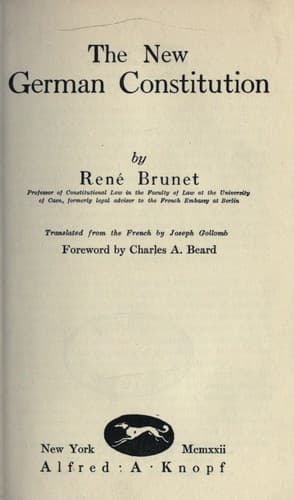
Germany -- Politics and government -- 1918-1933; Germany. Verfassung (1919)
The second permanent committee provided by the Constitution has as its
purpose the control of the activity of the Cabinet of the Reich when the
Reichstag is not in session, between the last meeting of one Reichstag
and the opening of a new one.
This committee, which is formed on the model of an institution already in
existence before the Revolution in the Grand Duchy of Baden, is supposed,
during the period which the Reichstag is not assembled, to safeguard the
right of popular representation against the Cabinet of the Reich. It
must see to it in a permanent fashion that administration is conducted
in conformity with laws, with the decisions of the Reichstag, and the
will of the people. It may not sit except when the Reichstag is not in
session. It has also the powers of an investigating committee.
When the Constitution was being discussed, prior to its adoption, this
committee, too, was the subject of much lively opposition. Some held
that the Cabinet, so long as it enjoyed the confidence of the Reichstag,
did not require a special organ of surveillance. This committee, its
opponents went on, was only an application of the conception that assumed
an opposition between the Cabinet and popular representation. It was
incompatible, therefore, with the principle of parliamentarism that rests
on a harmony of the Cabinet and the Parliament. But the majority of
the National Assembly held, on the contrary, that this committee would
correspond fully in character to the Reichstag as an organ of control,
and would be consistent with the confidence and the good will on which
the Cabinet depends.
SECTION II
THE PRESIDENT OF THE REICH
The parliamentary system assumes, by the side of the Parliament elected
by the people, a titular chief of state with executive power who,
himself not responsible politically but assisted by ministers who are
responsible, co-operates with Parliament in the different functions of
the state. Basing itself, therefore, on the principle of parliamentary
government, the German Constitution places at the head of the Reich a
President whose situation corresponds generally to that of all the chiefs
of state in parliamentary countries. The Constitution also attempts to
create within the general framework of the parliamentary system, a new
type of chief of state. It is important therefore to examine precisely
the principal characteristics of these provisions.
1.--THE NEED FOR A STRONG PRESIDENT
The dominant idea, which guided the constituent assembly when they
drew up the provisions relative to the President, was this: the German
parliamentary republic requires that its President shall be powerful.
Public-domain text, read in full here on John Shaqi.
Reviews
Reviews
No reviews yet
Be the first to share your thoughts on this work.
Elsewhere in the archive
Join the Discussion
Join the discussion
Sign in to leave a comment or review.
Sign InorCreate an account