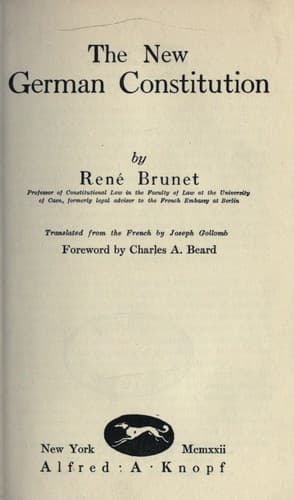
Germany -- Politics and government -- 1918-1933; Germany. Verfassung (1919)
There must be a President. The Independents did not want one. “The
President will either take his position strictly within the limits of
the functions which are his according to the parliamentary principle,”
said their spokesman, Haase, “in which case it will be his ministers who
will exercise his powers. He will thus play a purely ornamental rôle,
therefore useless and one for which the German Republic cannot afford
to pay. Or he will exceed his legal powers, and the Cabinet will be
compelled to develop in the direction of a régime of personal autocracy.
It is enough, for the purpose of government of the country, that there
should operate a Ministry in harmony with the popular representation.”[39]
These ideas had no chance to prevail. In committee Preuss fought them
energetically. The President, he held, could be replaced in two ways;
either by a directorate elected by the people or by one elected by
Parliament. The directorate would itself name its ministers. A Cabinet
thus composed would be doomed to inertia and incapable of making any
decision would “cry for a Bonaparte.” The Ministers who should be
responsible to the Parliament would be practically deprived of authority,
and the Parliament, with control only over the Ministers, would itself
be weakened. The following system could also be considered: Parliament
could directly elect a college whose members would themselves administer
the various ministerial departments; that is to say, instead of being
appointed by the President, Ministers would be elected by Parliament.
This is the Swiss system. But such a Cabinet, admissible in a small
country, could not exist in Germany, for the distribution of portfolios
depends not according to merely logical premises but according to the
relative strength among the different parties of the Reichstag. There
could be no unity of direction in a Ministry thus composed. Above all
what was needed was a personage who should be in the Constitution a
firm centre. The more committees there are, and the more elections, the
greater also becomes the need of having a fixed point to which may be
attached the various strands in the network of the Constitution. There
must therefore be a President.
This President must be powerful. A powerful chief of state is necessary
above all in Germany, where people like to be governed. This is
particularly necessary in such a revolutionary period as the Reich is
traversing. There must be a President who will be a worthy representative
of the nation and who will adequately personify, with all the authority
needed, a state as considerable as the Reich. The President must be
powerful in order also to act as a balance to the Parliament, which
without it might become omnipotent.
Public-domain text, read in full here on John Shaqi.
Reviews
Reviews
No reviews yet
Be the first to share your thoughts on this work.
Elsewhere in the archive
Join the Discussion
Join the discussion
Sign in to leave a comment or review.
Sign InorCreate an account