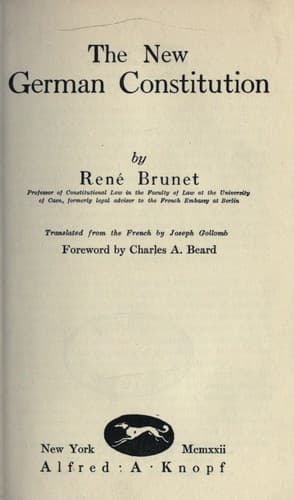
Germany -- Politics and government -- 1918-1933; Germany. Verfassung (1919)
This is why, first of all, the President of the Reich must not resemble
the President of the French Republic. The fact that in France the
President is elected by the National Assembly engenders a constitutional
situation full of inconveniences. The President there is only a purely
representative figure, Parliament having acquired absolute omnipotence
which is directly contrary to true democracy. The parliamentarism which
Germany wants is a parliamentarism whose mechanism is controlled by the
people; and not a parliamentarism in which the President is reduced to
complete inactivity and has no other care than to remain on the best
possible terms with the Chambers. The members of the Constituent Assembly
in supporting this condemnation--unanimous in Germany--of the French
system quoted Professor Redslob, according to whom parliamentarism in
France is completely adulterated.[40]
But neither must the President of the Reich resemble the President of the
United States. True, there were many in Germany at the end of 1918 and
at the beginning of 1919 who wished for a chief of state a man who could
act and represent the Reich with the independence and the authority of a
Wilson. But this wish does not seem to have prevailed. The Constituent
Assembly, in any event, wanted to inaugurate in Germany a parliamentary
régime; whereas in America, the House of Representatives has only
legislative power and the executive power rests wholly in the hands of
the President. The Assembly resolved to give the Reichstag the right
to co-operate in executive action and to exercise a control over the
administration. In addition the President in America himself nominates
his Cabinet without concern as to whether or not his Secretaries have
the confidence of the Chamber, to whom they are not responsible. He is
invested with a dangerous omnipotence, incompatible with parliamentary
régime. The American system therefore, like the French system, must be
rejected.
None of the forms of existing republican governments were entirely
suitable for the German Republic; there would have to be created for
its use a new type of chief of state. There would have to be created
for the first time true parliamentarism, different from the imperfect
parliamentarism such as exists in France. French parliamentarism consists
of the omnipotence of Parliament which for four years acts free of all
control on the part of the people. After each election democracy in
France plays no part. In the true parliamentarism, however, Parliament
is not omnipotent; but is subject to a control exercised by a democratic
authority and this authority must be, in Germany, a President.
Public-domain text, read in full here on John Shaqi.
Reviews
Reviews
No reviews yet
Be the first to share your thoughts on this work.
Elsewhere in the archive
Join the Discussion
Join the discussion
Sign in to leave a comment or review.
Sign InorCreate an account