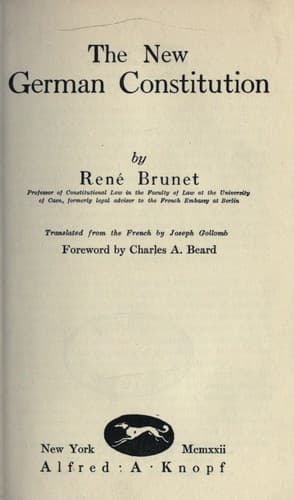
Germany -- Politics and government -- 1918-1933; Germany. Verfassung (1919)
Having condemned this method of election, the committee adopted the
proposal that seemed to them most opposed to this: that candidate should
be elected who received on the first ballot the largest number of
votes (a relative majority). If this system did away with some of the
inconveniences of balloting, there nevertheless could be urged against it
and with greater force the same objection as filed against the preceding
proposition, viz., that, given the division of political parties as it
was, a man could be called to the head of the nation who would have
behind him a relatively small fraction of the German population.
According to a third proposition, the second balloting could be avoided
in the following fashion. The elector would be permitted to indicate on
the first ballot a second person to whom he would give his vote should
his first candidate not obtain the necessary number of votes. This
proposition had as its point of view the idea that neighbouring groups
or parties could in this way and in advance effect electoral compromises
in the event that none of their candidates alone should survive the
first ballot. In this way there would be the advantage that a second
ballot would be unnecessary. But this system was not without danger,
for first of all it lacked simplicity, and again there was nothing to
show that the electors would thereby abide by the agreements concluded
by their parties. A well disciplined party, in which the electors held
to the agreements made by the chiefs of their party would risk being
put at a disadvantage by this system in relation to a party in which
there was no discipline whatever. There was the danger in accepting this
proposition that the elections would bring about a result that would not
truly express the real wish of the people, but which would depend on the
tactics and the more or less effective discipline of the parties.
Public-domain text, read in full here on John Shaqi.
Reviews
Reviews
No reviews yet
Be the first to share your thoughts on this work.
Elsewhere in the archive
Join the Discussion
Join the discussion
Sign in to leave a comment or review.
Sign InorCreate an account