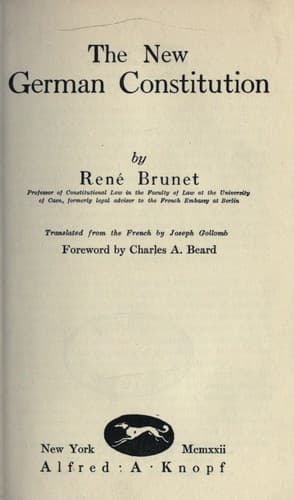
Germany -- Politics and government -- 1918-1933; Germany. Verfassung (1919)
None of these propositions having been accepted only one procedure
remained possible. This was to have two ballots, but not to limit the
second ballot to two candidates and to declare elected the candidate
who has received the largest number of votes. Thus, no group is obliged
to deprive itself of a candidate who might be able to win. But when the
different candidates have measured their strength on the first ballot,
the parties could then freely come to agreement based on precise results.
Nor would it be indispensable that this agreement should be based purely
and simply on the proportion of votes obtained on the first ballot.
Parties could agree on a candidate who on the first ballot had not been
presented. It could be hoped that the political situation, being to some
degree cleared by the first vote, there would be a considerable decrease
in the number of candidates, with the result that the President elected
would receive the majority of all the votes; or at least that he would
obtain a number of votes much larger than if he were considered elected
on the first ballot by a merely relative majority. The vote which a
candidate would thus obtain would be given him by the free choice of the
population; he would be much more the man trusted by the people than he
would be if a majority of the electors had voted for him constrained by a
balloting procedure. But the doing away with the second ballot could not
be accomplished without at the same time losing the clearness with which
the popular will should express itself.
Such is the system which was finally adopted as law on the election of
the President, on March 4, 1920. According to the terms of Article 4
of this law, “The one who has obtained more than half of all the valid
votes is elected. If no one obtains this majority a second ballot must
be proceeded to, after which the candidate obtaining a plurality of the
valid votes shall be considered elected. In case candidates obtain an
equal number of votes election shall be decided by lot.”[41]
* * * * *
Public-domain text, read in full here on John Shaqi.
Reviews
Reviews
No reviews yet
Be the first to share your thoughts on this work.
Elsewhere in the archive
Join the Discussion
Join the discussion
Sign in to leave a comment or review.
Sign InorCreate an account