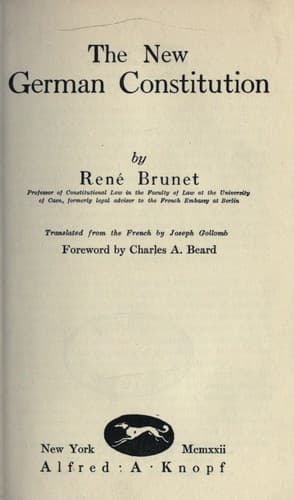
Germany -- Politics and government -- 1918-1933; Germany. Verfassung (1919)
The President exercises an extremely powerful control over the
legislative work of the Reichstag. When a law has been enacted he may,
before promulgating it, submit it to a referendum. He may, when the
Reichstag and the Reichsrat have declared urgent a law which they have
enacted, promulgate it immediately even if a third of the Reichstag has
demanded that its promulgation be deferred (Article 72). The aim of
such a demand for postponement is to give the opponents of the law the
chance to prepare a referendum and to proceed to it. The fact that the
President has the right not to act on such a postponement and to give the
law immediate operative power by promulgating it, offers him the chance
to prevent such a referendum. It is also in his right when there is no
agreement between the Reichstag and the Reichsrat on the text of a bill,
either to decide that the law is not in effect and shall not enter into
operation, or to decide for a referendum. He is free, finally, when a law
has been passed in the Reichstag by a two-thirds majority against the
protest of the Reichsrat, either to promulgate this law, or, if he does
not wish to take the responsibility of that, to submit to a referendum
the question on which the Reichstag and the Reichsrat disagree.
The President commands all the armed forces of the Reich. He is from this
point of view the direct successor of the Emperor. He has, therefore, the
power called _Reichsexecution_; that is to say, that when a state does
not carry out the obligations imposed upon it by the Constitution or by
a law of the Reich, he has the right to compel it to do so with the aid
of armed force. But, above all, he has the right to _declare a state of
siege_.
Public-domain text, read in full here on John Shaqi.
Reviews
Reviews
No reviews yet
Be the first to share your thoughts on this work.
Elsewhere in the archive
Join the Discussion
Join the discussion
Sign in to leave a comment or review.
Sign InorCreate an account