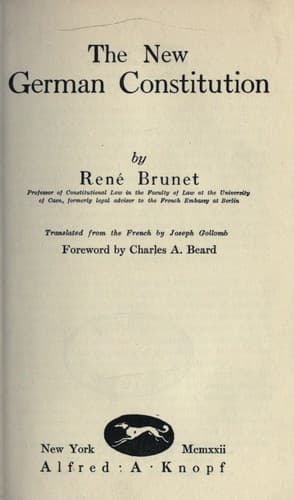
Germany -- Politics and government -- 1918-1933; Germany. Verfassung (1919)
The powers vested in the President of the Reich by the Constitution
are in general analogous to those possessed by every chief of state in
a parliamentary country. Just as the Reichstag exercises in addition
to its purely legislative powers a control over the Cabinet and its
administration, just so, if the principles of the parliamentary system
are to be applied, the President must be invested, in addition to his
strictly executive authority, with powers that permit him to co-operate
in legislative work and to exercise a control over the Reichstag itself.
It is precisely this, in effect, that the Constitution provides for. The
President of the Reich has executive powers. He nominates ministers, he
represents the Reich in foreign relations, he appoints all the civil
and military servants, he is supreme chief of the forces of the Reich
by land and sea, he exercises the right of pardon and he may make
regulations.[42] He has also powers of a legislative character. He alone
has authority to promulgate and publish enacted laws. He exercises a kind
of right of veto over these laws; and he may, according to circumstances,
in the complicated conditions we have already examined, either retard the
entrance of these laws into operation, or submit them to the people by
means of a referendum. Finally, he exercises a certain control over the
Reichstag. He may order the President of the Reichstag to convoke that
Assembly earlier than the normal date of its meeting. He nominates the
judicial members of the electoral commission for disputed elections to
the Reichstag. He may dissolve the Reichstag, etc.
It goes without saying that in none of these cases can the President
take action without securing the support and the countersignature of a
Minister. That is the essential condition of a parliamentary régime.
But to strengthen the action of a President and to give his position a
place of real pre-eminence, which is desired for him, the Constitution
entrusts him with a certain number of powers, which we must note
particularly, for they are perhaps peculiar to the German Presidency, and
give it a special character.
Public-domain text, read in full here on John Shaqi.
Reviews
Reviews
No reviews yet
Be the first to share your thoughts on this work.
Elsewhere in the archive
Join the Discussion
Join the discussion
Sign in to leave a comment or review.
Sign InorCreate an account