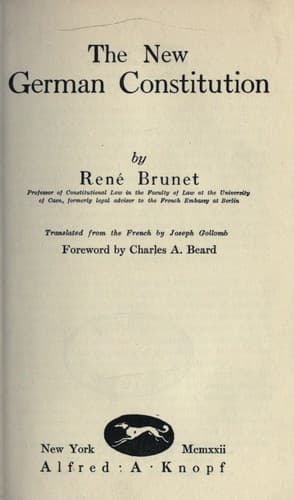
Germany -- Politics and government -- 1918-1933; Germany. Verfassung (1919)
The situation is quite analogous in reference to the dissolution of a
Reichstag. If the President dissolves the Reichstag and wants to prevail
over its majority he can no longer retain the Ministry supported by this
majority. Dissolution results from the fact that the President seeks, by
a new election, to change the majority to a minority and the minority to
a majority. He must therefore ask himself this question. What political
combination can I use? Such a calculation must be faced if it is not
permitted the President to prescribe a dissolution of the Reichstag
except with the countersignature of a Minister. The President is not
absolutely subject to the majority; he may attempt, in appealing to the
people, to make another majority of the minority, but in that case he
must take into this minority statesmen who will accept the responsibility
for such an attempt.
The President may, therefore, order the referendum and dissolve the
Reichstag; but these two decisions, like all the others, must be
countersigned by a Minister.
* * * * *
In addition to the powers we have just examined, all of which are
expressly provided by the Constitution, there are others which the
President possesses because they logically follow from even the practice
of a parliamentary régime. Certainly he has the right to demand reports
from Ministers and any information from them on the course of affairs. He
has the right also to be present at sessions of the Cabinet; and while
it is true that he has not the right to vote there, he may come there
whenever he pleases and take the chair.[44]
4.--THE RESPONSIBILITY OF THE PRESIDENT.
Responsibility engenders authority and there is no authority without
responsibility. Whatever powers a Constitution may give its chief of
state, they will rest a dead letter if he cannot personally assume
the responsibility for the exercise of these powers. The President of
the United States, who is thus held responsible, really governs. In
a parliamentary régime the chief of state is not responsible; thence
comes its weakness. But the German Constitution desires at once a
parliamentary régime and a strong presidency. It must therefore seek a
ground for the combination of the two.
(1) _Politically_ the President of the Reich is in theory not
responsible. That is to say, that he cannot be overthrown by vote of
lack of confidence on the part of the Reichstag. All his acts must
be countersigned by a Minister, and it is the latter who takes the
responsibility for them and who alone suffers the consequences.
Public-domain text, read in full here on John Shaqi.
Reviews
Reviews
No reviews yet
Be the first to share your thoughts on this work.
Elsewhere in the archive
Join the Discussion
Join the discussion
Sign in to leave a comment or review.
Sign InorCreate an account