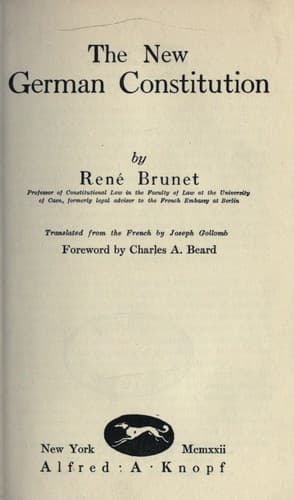
Germany -- Politics and government -- 1918-1933; Germany. Verfassung (1919)
There is, however, a limit to this political irresponsibility of the
President. If the conflict between the President and the Reichstag is
really irreconcilable he may submit the conflict to the people, who
decide. It is recalled to this effect that, according to Article 42, the
Reichstag by a decision taken by a majority of two-thirds may demand of
the people a vote on the impeachment of the President. If the people
approve, the President ceases his functions; therein operates a kind of
political responsibility of the President.
(2) The President of the Reich is criminally responsible. Two hypotheses
must be considered:
(_a_) The President may have committed some crime for which the ordinary
penal law prescribes punishment. Can he be prosecuted before ordinary
tribunals as an ordinary individual? This question was vigorously debated
before the Committee on the Constitution. It was not desired that the
President should be absolved from all criminal responsibility. But, on
the other hand, it was equally undesirable that he should be placed in
the same status as ordinary citizens, because this would give him a
position less favorable than that which the Constitution grants members
of the Reichstag. It was decided finally that, like the latter, he cannot
be criminally prosecuted during the term of his powers, except with the
authorization of the Reichstag.
(_b_) Or the President may be guilty of a violation of the Constitution
or a law of the Reich. In this case Article 59 provides that he may
be prosecuted by the Reichstag in the Supreme Judicial Court. The
proposal to bring an impeachment must be signed by at least one hundred
members and supported by a two-thirds majority. But it must be specified
here that this is a matter of legal procedure and that therefore this
prosecution can be based only on the violation of a definite provision
of the Constitution or of a law. In the case of a simple political
divergence of opinion between the Reichstag and the President, only the
political responsibility for the matter can be called into the question,
and the one way open to the Reichstag is that of an impeachment approved
by the people.
What penalty can the Supreme Judicial Court pronounce against the
President in case of a verdict of guilty? The Constituent Assembly at
first adopted a provision according to which the Court could simply
declare the President removed, or to declare him incapable of exercising
any public function whatever. Finally, however, it was decided to leave
this question to the law organizing the Court of Justice.
But the situation may arise in which an act committed by the President
constitutes both an infraction of the penal law as well as a violation of
the Constitution. Which shall pass first upon this, the ordinary tribunal
or the Supreme Judicial Court? After long hesitation, the Constituent
Assembly decided to leave this question also to the future law dealing
with the Supreme Judicial Court.
Public-domain text, read in full here on John Shaqi.
Reviews
Reviews
No reviews yet
Be the first to share your thoughts on this work.
Elsewhere in the archive
Join the Discussion
Join the discussion
Sign in to leave a comment or review.
Sign InorCreate an account