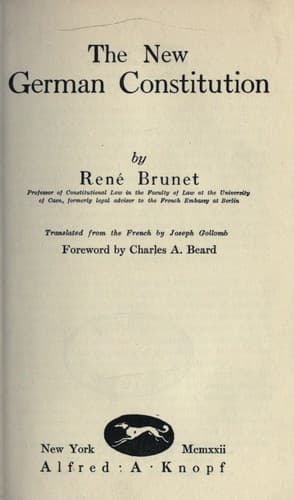
Germany -- Politics and government -- 1918-1933; Germany. Verfassung (1919)
When a ministerial crisis opens there commences at the same time a period
of difficult negotiations. Each political group meets and discusses
the position it will take, deciding whether or not it will accept
participation in the Cabinet. The answer to this latter question depends
most often upon whether certain other groups will participate themselves
in power. Then the trusted men or the leaders of the different parties
meet together to find a basis for agreement. The President of the Reich
naturally keeps in touch with these negotiations; sometimes they are held
in his presence. The programme of the future Cabinet is discussed and
above all the choice of future Ministers. When an agreement is reached
the President of the Reich makes his nominations. There was one occasion,
however, when the task of forming the Cabinet was extremely difficult.
It was after the elections of June 6, 1920, which gave to the various
parties such a distribution of numerical strength that no majority was
practically possible no matter what combination was tried. The various
groups met and quarrelled but were not able to come to agreement. Then
the President charged a member of the Centre, not to make up a Cabinet,
but to serve as an intermediary between the various parties and to bring
them to an agreement. It is from this preparation that there issued the
Ministry of Fehrenbach. _Thus the Cabinet is constituted not by an act,
a free decision of the President, but by an agreement reached by the
parties._
From this ensue two consequences:
First, these crises are very long. The one in which the Fehrenbach
Cabinet was formed lasted nineteen days. In a country whose situation is
as difficult in every respect as that of Germany, such a lapse of time
without a Cabinet, entirely taken up in deliberations and discussions
between politicians, is obviously a deplorable state of affairs.
Public-domain text, read in full here on John Shaqi.
Reviews
Reviews
No reviews yet
Be the first to share your thoughts on this work.
Elsewhere in the archive
Join the Discussion
Join the discussion
Sign in to leave a comment or review.
Sign InorCreate an account