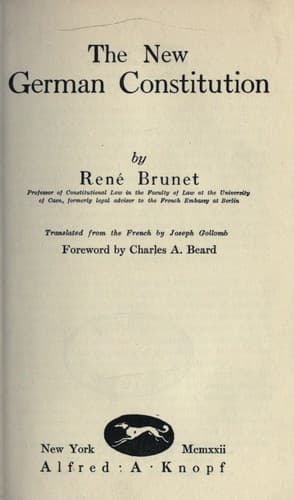
Germany -- Politics and government -- 1918-1933; Germany. Verfassung (1919)
(3) The preceding remarks suffice to explain the following fact: since
the establishment of the parliamentary régime in Germany _no Ministry has
ever been overturned_ by the Reichstag. How can it be, if it conforms to
the condition of its agreement and if, before each hazardous decision, it
assures itself the approval of the majority? On the other hand, if it
cannot obtain this approval, or if it does not want to accept the policy
desired by the majority groups, why should it go before the Assembly and
engage in a battle lost in advance? It resigns.
The Ministry, therefore, is never overthrown; it retreats, or more
correctly, it does not retreat, but changes. The number of men available
for a Ministry is very limited and the groups present almost always
the same men. There is in advance a certain knowledge as to who the
men are who will enter a Cabinet as soon as one knows what groups will
participate in the formation. Further, the possibilities of combinations
within a given Chamber are limited enough. From the beginning of
February, 1919, only four groups have participated in power, of these
the People’s Party participated only after June, 1920. It is inevitable,
therefore, that in each new combination there remain at least two groups
which already belonged to the preceding one. Quite naturally these groups
leave, without exception, the same men in power. Why change? An important
part of the preceding Ministry, therefore, is maintained in each new
Ministry.
In June, 1919, Scheidemann’s Cabinet, which consisted of Social
Democrats, Democrats and members of the Centre, was replaced by Bauer’s
Cabinet, in which only the Centre and the Social Democrats entered.
The members of these two groups which were in the Scheidemann Cabinet
remained in the Bauer Cabinet and it was sufficient to replace with
members of these two groups the vacancies left by Scheidemann and the
Democrats. In March, 1920, Bauer’s Cabinet, into which the Democrats
entered in October, 1919, attempted a new change after the _coup d’état_
of Kapp. Conferences took place, in which took part the President of
the Reich, the Ministers and representatives of parties, in which was
discussed the question as to which Ministers should remain and which must
go.
Public-domain text, read in full here on John Shaqi.
Reviews
Reviews
No reviews yet
Be the first to share your thoughts on this work.
Elsewhere in the archive
Join the Discussion
Join the discussion
Sign in to leave a comment or review.
Sign InorCreate an account