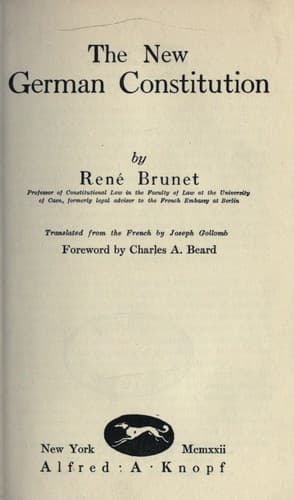
Germany -- Politics and government -- 1918-1933; Germany. Verfassung (1919)
The more the discussion was prolonged, the greater grew the number
of Ministers to remain. But the unions intervened and demanded the
resignation of the whole Cabinet. Bauer acceded. Nevertheless the
Cabinet, which was thereupon constituted by Hermann Müller, retained
several members of the preceding Cabinet, notably Hermann Müller himself,
who from Minister of Foreign Affairs became Chancellor, and Bauer, who
from Chancellor became Minister of the Treasury. The same procedure took
place in the constitution of the Fehrenbach Cabinet. It was expected that
a Ministry coming after elections that expressed a considerable change
in the political situation, and after the Social Democrats withdrew from
power and the People’s Party arrived, would translate this change by a
more profound modification than usual of the Cabinet. But out of thirteen
members five had been members of the preceding Cabinet.
It does not seem, therefore, that the attempt made by the Constitution to
regulate as precisely as it may be done the functioning of the government
of the Cabinet has had up to now any appreciable effect on the practice
of parliamentarism. Germany begins at a point that other countries,
in which parliamentary government has operated for years, have hardly
attained, if they have at all attained it. A concentrated Cabinet, a
Cabinet of republican defence, a Cabinet of transition, a _bloc_ of the
Centre--are these accidental deformities of the parliamentary régime,
or are they forms toward which it must necessarily tend? We are told
in Germany that these practices, obviously little compatible with the
conception of parliamentarism or with the regulations provided in their
Constitution, are to be explained by the state of revolution in which
the country still finds itself; and that they will disappear if some
day Germany recovers its equilibrium, and make place for a correct and
complete application of constitutional rule.
SECTION IV
THE REICHSRAT
The Reichsrat is placed by the Constitution by the side of the Reichstag,
the President and the Cabinet, and has as its rôle the representation,
after these, of the States of the Reich in legislative and administrative
matters.
1.--GENERAL FEATURES OF THE REICHSRAT.
The Reichsrat constitutes a bond of co-operation between the Reich and
the States. Whereas the will of the whole German people taken together
is manifested through the Reichstag, the Reichsrat translates the will
of the States, such as it is conceived by the governments or cabinets of
these States.
The Reichsrat is the representative in the Reich of the federalist
principle. It is the federalist organ of the Reich. In this rôle it joins
the unitary organs and completes them.
Public-domain text, read in full here on John Shaqi.
Reviews
Reviews
No reviews yet
Be the first to share your thoughts on this work.
Elsewhere in the archive
Join the Discussion
Join the discussion
Sign in to leave a comment or review.
Sign InorCreate an account