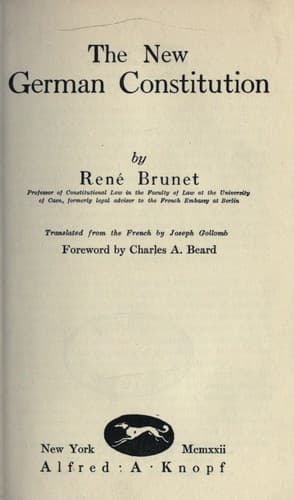
Germany -- Politics and government -- 1918-1933; Germany. Verfassung (1919)
The Reichsrat is the successor of the Commission of States of the
Provisional Constitution and of the Bundesrat of the old Constitution.
But as the unitary idea made important progress, the Reichstag
was endowed with powers considerably less extensive than those
of the Bundesrat. The latter, which represented the confederated
governments collectively, was the holder of sovereignty under the
Empire. The Reichsrat, on the other hand, since the new Constitution
placed sovereignty in the German people, is only an organ by which
the governments of the states participate in the legislative and
administrative powers of the Reich. Instead of being endowed, as compared
to the Reichstag, with powers equal or superior to it, as the former
Bundesrat was, it has received but very limited rights.
The question whether it would not have been better to organize instead
of the Reichsrat a Chamber of States, which would represent, not the
various cabinets, but the populations of the states, was vigorously
debated. It may be recalled that it was this solution Preuss proposed:
a Chamber of States composed of delegates of German republics. These
delegates would be elected by the Diets of the republics and would be
selected from among the citizens of these republics. In principle, each
state would have a delegate for each million inhabitants.
Such an organism would constitute a very characteristic application of
the centralist idea. But it was thought that this would create, by the
side of the Reichstag, a new popular representation, and that this would
not take into account the necessity of organizing a representation of
states. What was needed actually was the creation of an organ, within
which would be realized an equilibrium between the voices and the needs
of the Reich on the one hand and the voices and the needs of the states
on the other; if it was not wished to suppress completely the federal
structure of the Reich and make of it simply a unitary state. This
organism would have to include technical and vocational representatives
of the interests of the states, leaving aside the idea of parties and
all the programmes of parties. That is to say, there would have to be
representatives of the governments of the states, not merely political
representatives. The National Assembly decided on a Reichsrat organized
on the model of the former Bundesrat, representing the governments of the
states and endowed with less extensive powers.
The Reichsrat differs profoundly as to authority from the old Bundesrat.
It has lost completely the sovereign character of the Bundesrat. It has
not even the right to issue administrative regulations, this right having
been taken away from it and given to the Cabinet. It has ceased to be, in
comparison with the Reichstag, a legislative organ invested with rights
equal to those of the Reichstag; and it has no more than a very limited
right to co-operate with it in legislative work.
Public-domain text, read in full here on John Shaqi.
Reviews
Reviews
No reviews yet
Be the first to share your thoughts on this work.
Elsewhere in the archive
Join the Discussion
Join the discussion
Sign in to leave a comment or review.
Sign InorCreate an account