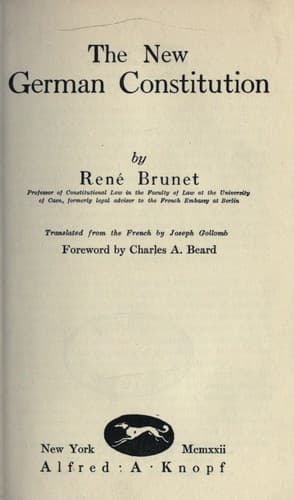
Germany -- Politics and government -- 1918-1933; Germany. Verfassung (1919)
The former Bundesrat was an organ which had in legislative matters
the same rights as the Reichstag. It exercised in addition important
executive functions; in particular it had the right to promulgate general
administrative regulations for executing the laws of the Reich. It was
the central administrative authority in matters relating to customs
and taxes. It decided conflicts of a constitutional character as well
as miscarriages of justice. Of all these powers few have descended to
the Reichsrat. In order to emphasize the idea of the unity of the Reich
and of the sovereignty of the whole German people in the Reich, the new
Constitution limits to a considerable extent the powers of the Reichsrat.
However, it has left it a certain right to participate in the making of
laws and in the exercise of executive power.
In legislative matters, it will be recalled, that all proposals of
laws on the part of the Cabinet must be presented at first to the
Reichsrat; in theory, must be accepted by it before being submitted to
the Reichstag. But as we know this consent is not indispensable and the
government may disregard it. It will be recalled also that the Reichsrat
has the right to protest against any law voted by the Reichstag; but that
it may have its protest disregarded under certain conditions.
Already the Reichsrat has made use of its right of protest. That was
done in connection with a bill that raised postal taxes. The National
Assembly, acting in the character of the Reichstag, had voted a provision
according to the terms of which the sending by mail of official documents
would have to be paid for, no longer by him who received them, but
by the sender. The representatives of Prussia, Bavaria and of Saxony
criticized in the Reichsrat this measure, and found support in the
Assembly to the extent of a majority of thirty-eight votes. Whereupon
the Reichsrat raised a protest against this measure, April 29, 1920.
The bill then returned to the National Assembly; but the conflict ended
with a compromise, without recourse to the procedure provided by the
Constitution for such a case.
The Reichsrat still possesses some executive powers. On the one hand, the
Constitution and the law frequently stipulate that a regulation by the
Cabinet of the Reich must be authorized by the Reichsrat. On the other
hand, the law of April 17, 1919, “for a simplified form of legislation
on economic matters” provides that regulations decreed by the Cabinet in
this matter must be approved both by the Reichsrat and by a committee of
twenty-eight members of the Assembly. The Reichsrat and the Committee
have in this case absolutely equal rights. Finally Article 67 provides
that the Reichsrat must be kept informed by the national departments of
the conduct of national business.
CHAPTER V
FUNDAMENTAL RIGHTS AND DUTIES OF GERMANS
Public-domain text, read in full here on John Shaqi.
Reviews
Reviews
No reviews yet
Be the first to share your thoughts on this work.
Elsewhere in the archive
Join the Discussion
Join the discussion
Sign in to leave a comment or review.
Sign InorCreate an account