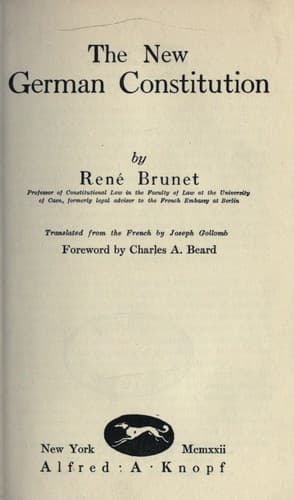
Germany -- Politics and government -- 1918-1933; Germany. Verfassung (1919)
The second part of the Constitution of Weimar is devoted entirely to the
fundamental rights and duties of Germans. It is the Declaration of Rights
of the new Germany. Aside from several articles relating exclusively to
the economic organization of the Reich, the five sections of this part
contain a long enumeration of the rights and duties granted to or imposed
on the Germans. To enter into details of this enumeration would be to
undertake a study of all of German public and private law. Nevertheless
an attempt must be made to outline the principal ideas.
1.--LEGAL AND POLITICAL ASPECTS OF FUNDAMENTAL RIGHTS AND DUTIES.
The articles relative to fundamental rights and duties, during the
discussion of the draft of the Constitution, were the subjects of lively
differences of opinion. It was questioned whether it was necessary and
useful to insert such provisions into the Constitution; moreover, every
one of these provisions one after another was debated. The Bismarckian
Constitution of 1871 contains no declaration of rights. On the other
hand, the drafters of the Constitution of 1849 proposed such a great
number of fundamental rights and applied themselves with such complacence
to the elaboration of these rights that the Constituent Assembly of
that time was unable to make itself heeded, and this defeat contributed
largely to the defeat of the whole of the project of such rights.
The first proposal of the Cabinet following the tradition of the proposal
of 1849 and also the Declaration of Rights of the French Revolution, as
well as of the American, Belgian and Prussian Constitutions, enumerated
in a few paragraphs several essential legal principles and enunciated
some fundamental dogmas which have been considered for a century and in
all civilized countries as self-evident truths. But in the Constitutional
Committee the discussion went far beyond these generalities. Desirous of
creating an intellectual background in which justice and administration
would have to operate, desiring also to furnish in the form of some
suggestive maxims a guide for the conduct of some of the most important
matters in the legal domain, and to furnish a solid foundation for the
juridical culture of the German people, the members of the Constitutional
Committee nominated a sub-committee, which prepared a new draft whose
provisions were embodied in the draft of the Cabinet, in different bills
prepared on private initiative, as well as in the new Constitutions of
Baden and Wurtemberg. In the drawing up of this new draft the principal
rôle was played by Beyerle, member of the Centre.
Public-domain text, read in full here on John Shaqi.
Reviews
Reviews
No reviews yet
Be the first to share your thoughts on this work.
Elsewhere in the archive
Join the Discussion
Join the discussion
Sign in to leave a comment or review.
Sign InorCreate an account