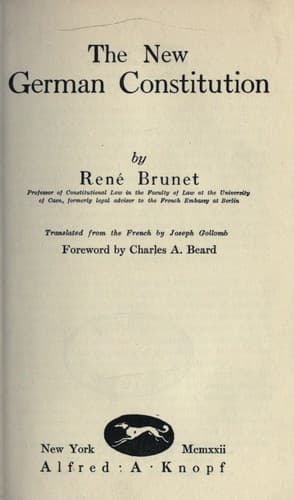
Germany -- Politics and government -- 1918-1933; Germany. Verfassung (1919)
In the course of the discussions in sub-committee, in Committee, as
well as in plenary session, three currents appeared. Some wanted to
suppress drastically all declarations of rights in the Constitution of
the Reich; for they saw in these principles no stable system, but only
a collection of “declarations and declamations,” to which were joined
some legal maxims figuring already in other laws. Others wanted to
retain the system embodied in the cabinet draft, adding to it, however,
several provisions to assure the protection of the rights acquired for
religious denominations. A third group, among whom principally was
Frederick Naumann, held that the cabinet draft, even thus extended, was
retrogression and did not correspond to the actual development of German
culture. They demanded that there be substituted for it a declaration of
fundamental rights which would constitute a recognition of the principal
ideas that characterize the most recent development of this culture.
The Constitutional Committee, and after it the National Assembly itself,
adopted a middle course. The propositions by Naumann as a whole were
rejected; and it was decided not to inscribe in the Constitution, in
political sentences and aphorisms without any legal content, a complete
and solemn recognition of the directing ideas of the present and of
the future. Nevertheless there would be inserted in the Constitution a
certain number of political maxims and of “programme thoughts.” This
done, the Constituent Assembly wished, in the words of Düringer, to give
a foundation to the existing legal culture, and to furnish a mirror
to German juridical life, and at the same time afford a programme for
future juridical development. In addition the principles voted, since
they would figure in the text of the Constitution, would have to be
placed under the express guarantee of the Constitution and thus become
part of the fundamental law of the Reich. The Assembly hoped, finally,
that these articles would exercise a certain educational function. They
would constitute the basis of the civic and political education of the
people. The fundamental rights would have to be not only “the keystone of
the edifice, but must also become the substance whereby the Constitution
would live.”
This was a magnificent programme; unfortunately it was difficult to
carry it out and the most severe criticisms were rightly, it seems, made
against the manner in which it was carried out.
Public-domain text, read in full here on John Shaqi.
Reviews
Reviews
No reviews yet
Be the first to share your thoughts on this work.
Elsewhere in the archive
Join the Discussion
Join the discussion
Sign in to leave a comment or review.
Sign InorCreate an account