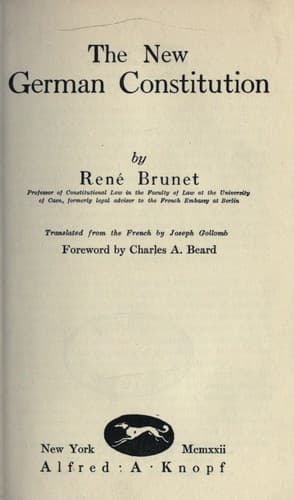
Germany -- Politics and government -- 1918-1933; Germany. Verfassung (1919)
The enumeration of rights and duties is complete, but the idea that
prevailed at its adoption is different from that which inspired the
authors of preceding Declarations of Rights. In recognizing the liberties
of the individual, the object is no longer to protect him against the
State, but to permit him to co-operate in the most effective fashion in
the well-being of all.
This leads naturally to the imposition on the liberty of the individual
of a certain number of restrictions hitherto unknown. On the other hand,
it imposes on the state a certain number of new duties, the discharge of
which affords, as corollaries, new rights to the individual.
I.--INDIVIDUAL RIGHTS ARE SUBJECT TO CERTAIN NEW RESTRICTIONS IN THE
INTERESTS OF THE COLLECTIVITY.--The individual is no longer merely
entitled to work. _It is his duty._ This obligation is provided for by
Article 1, par. 1, of the socialization law of March 23, 1919, which
has become Article 163, par. 1, of the Constitution. “Every German has,
without prejudice to his personal liberty, the moral duty so to use his
intellectual and physical powers as is demanded by the welfare of the
community.”[49]
It is true, therefore, that personal liberty is conditioned. The draft
of the socialization law submitted by the Cabinet did not contain these
conditions, and the Social Democratic Minister, Wissel, in open session
of the National Assembly, expressly rejected the principle of the liberty
of the individual. In the same manner the Social Democrats and the
Independents proposed amendments according to which the sole liberty
guaranteed to the individual was that of choosing his profession; this
one right availed of, the liberty of the individual was thereupon used
up, and he must thereafter conduct himself exclusively according to the
needs of community. But a coalition of all the representatives of the
bourgeois parties organizing against the conceptions behind the Socialist
proposal, the provision concerning the principle of the liberty of
employment was introduced into the law of March 23, 1919, and into the
Constitution.
Saving his personal liberty, therefore, every German also has work as
his moral duty; that is to say, he should contribute all the economic
work that he is capable of according to his physical and intellectual
abilities. In addition, this work must correspond to a definite
condition; it must be such as is “demanded by the welfare of the
community.”
Public-domain text, read in full here on John Shaqi.
Reviews
Reviews
No reviews yet
Be the first to share your thoughts on this work.
Elsewhere in the archive
Join the Discussion
Join the discussion
Sign in to leave a comment or review.
Sign InorCreate an account