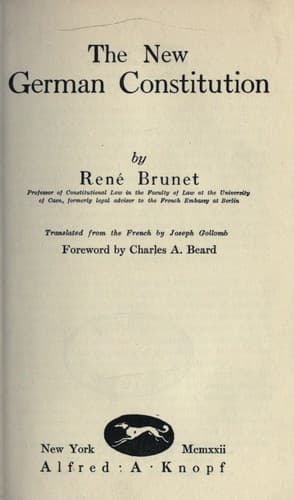
Germany -- Politics and government -- 1918-1933; Germany. Verfassung (1919)
In Germany many see in this provision a central point of the law and
hold that it constitutes as a real transition from the old world to the
new. Formerly every German could, under the protection of the law, so
dispose of his work that it served only his selfish ends. Without regard
to the interests of his fellow citizens or those of the community,
he could, provided that he observed the outer forms of the law, so
to speak, “walk over dead bodies” without violating a single legal
provision. In a general way and aside from insignificant exceptions,
there reigned in the century of economic liberalism an unlimited egoism
of the individual, protected by the adage _qui jure suo utitur, nemine
lædit_. The socialization law radically changed this state of affairs.
Hereafter every German is obliged, for the well-being of the whole German
people, to furnish all the productive labor of which he is capable, and
must abstain from all action liable to hinder this well-being. It is only
within these limits that economic egoism may hereafter move.
However, this novel duty to work is as yet only a “moral duty.” These
words, which were not found in the original draft by the Cabinet, were
added by the Constitutional Committee; and the Independents tried, but
in vain, to have them omitted. It does not seem, however, that the
majority which has adopted them, has ever given them a clear, unequivocal
meaning. One thing is clear, however; the law wished to distinguish
between a moral duty and a positive legal obligation, whose execution
can be expressly compelled. But it is perhaps possible to interpret
this provision in such a way that the violation of the duty to work may
involve legal consequences, which can have as a result the right on the
part of the state to exercise indirect constraint on the individual who
does not carry out his duty. The German who does not work, or who lets
himself be dominated in his work by purely selfish ends, has no longer
the right to demand protection of the laws; he cannot demand that his
work shall be protected by the Reich. Perhaps one may even go so far as
to appeal to the article of the Civil Code, according to which all legal
procedure that violates good morals is null;[50] and hold it applicable
to acts and contracts that do not correspond to the moral duty imposed
by the socialization law and by the Constitution. In the same way perhaps
also Article 826 of the Civil Code may be applied, according to which any
one who in a manner contrary to good morals deliberately causes damage
to others is obliged to repair this damage; and it may be argued that an
act or contract inspired by a selfish end falls under the provision of
this law and brings about in such a case an obligation to compensate the
community.
Public-domain text, read in full here on John Shaqi.
Reviews
Reviews
No reviews yet
Be the first to share your thoughts on this work.
Elsewhere in the archive
Join the Discussion
Join the discussion
Sign in to leave a comment or review.
Sign InorCreate an account