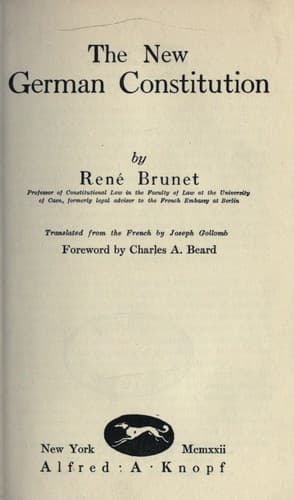
Germany -- Politics and government -- 1918-1933; Germany. Verfassung (1919)
Declarations of Rights generally contain, justly so, principles
relative to religious liberty and the free exercise of creeds. But
the Constitution of Weimar could not limit itself on this point to
traditional general maxims. The question of the relations of church and
state forms an essential article of the programme of the Centre, and also
of the programme of the Social Democrats. Their solutions would seem to
be self-contradictory. The Centre wanted to guarantee to the Church a
privileged and preponderant situation within the State. The programme
of Erfurt, on the other hand, declared religion to be a purely private
matter, and refused all subsidies levied on public resources in behalf
of ecclesiastical or religious needs. But these two parties entered
at that moment into a coalition which, together with the Democrats,
governed the Reich. As neither of these two opposed conceptions was able
to prevail, the conflict of the two theories was finally settled by a
compromise--which before consummation required laborious negotiations.
* * * * *
The Constitution first proclaims the principle of liberty of belief
and conscience and the free exercise of religion. These liberties are
expressly placed by the Constitution under the protection of the
State. They are guaranteed against every invasion no matter from what
side it comes. But the general laws of the State remain intact and
religious liberty finds itself limited by the general regulations for the
maintenance of order and public security. Every abuse in the exercise of
religious liberty is punished by ordinary law. Civil rights and duties
must not be restrained or conditioned by the exercise of religious
liberty. The enjoyment of civil and civic rights as well as the admission
to public employ are independent of the religion professed. No one is
obliged to divulge his or her religious convictions before any authority
whatsoever, and the right of an authority to inquire into the sect to
which one belongs may not be exercised except as one’s rights and duties
depend upon this, as, for example, in the matter of church tithes or
in the matter of guardianship or instruction; or where it is necessary
for the gathering of statistics ordered by law. No one may be forced to
attend any Church ceremony or to take part in any religious exercise.
No one may be forced to make use of any religious oath as was formerly
prescribed in civil and penal procedure. It is sufficient, in taking an
oath, that the one swearing shall declare without a religious formula, “I
swear!”
On the other hand, the Constitution contains several provisions regarding
the exercise of religion. Sundays and legal holidays remain protected by
law as days of rest and spiritual edification.
Public-domain text, read in full here on John Shaqi.
Reviews
Reviews
No reviews yet
Be the first to share your thoughts on this work.
Elsewhere in the archive
Join the Discussion
Join the discussion
Sign in to leave a comment or review.
Sign InorCreate an account