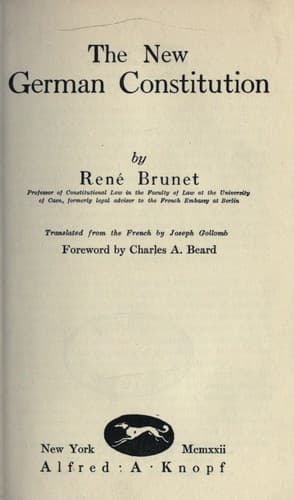
Germany -- Politics and government -- 1918-1933; Germany. Verfassung (1919)
These principles being admitted, there still remained the difficult
problem of the relations of State and Church. The following solution was
adopted: There is neither complete separation nor any close union of the
Churches and the State. The Churches are emancipated from the State, but
they enjoy certain privileges.
_The Churches are free._ “There is no State Church.” The union that
formerly existed between the Church and the State, in Prussia, for
example, and in the majority of the German States between them and the
evangelical church, has disappeared, and the principle according to which
religious affairs depend upon the state is abolished.
This freedom of the Churches is manifested first, in that the creation
of religious denominations and sects is free, and that the assembly of
religious denominations in associations within the Reich is subject to
no limitation whatever. It is also revealed in the complete independence
of the Churches in regard to the State. Each religious denomination
administers and conducts its affairs freely, provided that it observes
the laws that apply to all. It conducts its work without the co-operation
of the State or of the municipality. The new system realizes thus the
emancipation of ecclesiastical administration from secular control. The
State may neither decree regulations affecting faith, nor appoint any one
to ecclesiastical service nor demand that its assent be required to the
nominations made by ecclesiastical authority.
However, the Constitution does not push the principle of the separation
of Church and State to such a point as to allow religious denominations
no more than the merely private rights accorded by law to natural
persons. Recognizing the social force and the importance in public life
exercised by the Churches, the Constitution accords them _privileges
similar to those given to public corporations_. Religious denominations
existing in Germany at the time of the adoption of the Constitution
remain recognized as public corporate bodies. As for other similar
organizations, the same rights are accorded them on the motion of the
state government if, by their constitution and the sufficient number of
their adherents, they offer guarantees of permanence. While recognizing
that in theory the smaller religious groups, chapels, and sects may be
invested with rights similar to those of the principal churches, the
object of the above limitation is to prevent ephemeral organizations from
acquiring the standing of public corporate bodies.
Public-domain text, read in full here on John Shaqi.
Reviews
Reviews
No reviews yet
Be the first to share your thoughts on this work.
Elsewhere in the archive
Join the Discussion
Join the discussion
Sign in to leave a comment or review.
Sign InorCreate an account