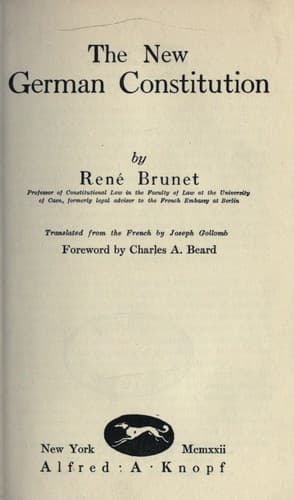
Germany -- Politics and government -- 1918-1933; Germany. Verfassung (1919)
But public secular schools and public denominational schools, properly
so-called, also may continue, and their existence is constitutionally
guaranteed. These schools, by the same title as the mixed schools, are
elementary schools, on which may be based secondary and higher education.
But these cannot be established in municipalities except under certain
specified conditions. There must first be a formal demand on the part
of a sufficient number of heads of families. Then the organization of
the school asked for must conform to high educational standards. From
all this it may be concluded that the system of the uniform school and
the transition from the public school to secondary and higher schools
must not be interfered with. In addition, the arrangement of instruction
based on the diverse vocational needs, must not be made impossible.
Finally, public instruction must not be handicapped by the unnecessary
establishment of useless and inefficient schools. The wishes of heads of
families, as far as possible and in accordance with the above conditions,
must be taken into consideration and their proposals accepted. Questions
of detail, such as, what is understood by “head of a family”; how
many such are sufficient within a municipality to be able to demand a
sectarian or a secular school; how many schools there shall be and of
what kind, must be settled by educational laws of the Reich and by laws
of the States which must follow those of the Reich.
* * * * *
II.--_Private instruction is permitted._ (Article 142.) However, this
liberty is subject to important restrictions (Article 147) in the case of
private schools considered as substitutes for public schools.
In general, establishments of private instruction, no matter of what
grade, can be created only _by the authorization of the State_. This
authorization is subject to the following conditions: the programme
and the equipment of private schools must not fall below the programme
and equipment of public schools. The scientific training of teachers of
private schools must be of as high a standard as that of public school
teachers. The economic and legal position of private school teachers must
be guaranteed. Finally, private schools cannot become the schools of
class or caste.
Elementary private schools are subjected by the Constitution to several
special conditions. Their establishment is authorized when in any
municipality there does not exist for a minority of heads of families,
whose needs must be considered, a public school of their denomination,
or one that conforms to their ethical system. Such a school may also be
established if educational authorities recognize in the demands of such
a group a special pedagogical interest. The Constitutional provisions
relating to programmes and free instruction apply also to private
elementary schools.
Private preparatory schools are abolished.
Public-domain text, read in full here on John Shaqi.
Reviews
Reviews
No reviews yet
Be the first to share your thoughts on this work.
Elsewhere in the archive
Join the Discussion
Join the discussion
Sign in to leave a comment or review.
Sign InorCreate an account