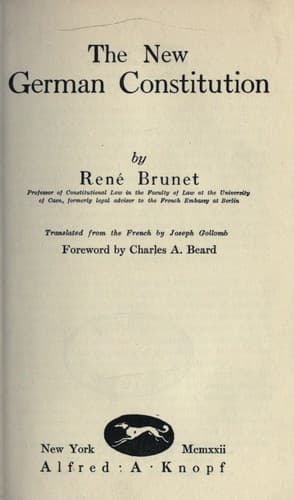
Germany -- Politics and government -- 1918-1933; Germany. Verfassung (1919)
Finally, for private schools that are not substitutes for public schools,
such as commercial and professional schools, the laws formerly in
existence still operate.
* * * * *
III.--The Constitution contains a number of provisions for instruction,
both public and private. It provides that vocational instruction and
moral and civic education shall be part of the programme of all schools.
By means of vocational instruction children must be made to understand
the great importance of work, for the individual as well as for society
as a whole. Civic instruction must acquaint children with the rights and
duties of citizens, with the organization of the German State, and with
the public life of Germany. To this end, every scholar on completion
of the course in compulsory education shall receive a copy of the
Constitution.
* * * * *
Such are the provisions relative to instruction in the schools. They
constitute, as compared to the former state of affairs, a considerable
change. But these provisions cannot be effectively put into operation
except by a series of laws on the part of the Reich as well as of the
States, a process which threatens to be a long one in point of time.
However, in April, 1920, the first law on this matter was passed by the
National Assembly. It was the law _on the elementary school_. According
to this law, primary schools must be so organized that the first four
years may at the same time serve as a preparation for secondary and
higher education. Every child who has successfully graduated from the
highest class of the elementary school must be sufficiently prepared to
enter immediately a secondary or a higher school. Public preparatory
schools and public preparatory classes are abolished. As for private
preparatory schools, their suppression will take place only after a
sufficiently long reprieve; their complete abolition need not take place
until the commencement of the school year 1929-1930; since economic
difficulties prevent the earlier abolition of these schools, and means
must be taken to provide for the teachers who will be deprived thus
of their occupations. Private instruction is not allowed except in
particular cases and can only in special circumstances be substituted for
the elementary school. The law does not touch instruction and training
in auxiliary classes; nor does it concern itself with the instruction of
children physically or mentally diseased.
Public-domain text, read in full here on John Shaqi.
Reviews
Reviews
No reviews yet
Be the first to share your thoughts on this work.
Elsewhere in the archive
Join the Discussion
Join the discussion
Sign in to leave a comment or review.
Sign InorCreate an account