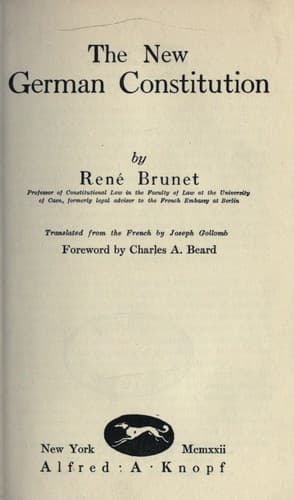
Germany -- Politics and government -- 1918-1933; Germany. Verfassung (1919)
But the Socialists, followed on this point by the National Assembly,
held that these reforms were only preparatory in character. True
economic democracy can not content itself with the mere recognition of
workers’ organizations and collective bargaining. Economic democracy
cannot be established and therefore economic and social transformation
cannot be effected, unless the working class can exercise on production
the influence that is its due. There must be provided an organization
that accords the workers the right to participate actively in the
determination of the ends and of the duties of the vocation and the
enterprise; which makes of the workers co-operators with the capitalist.
There must be in every district, in the states and in the Reich an
economic representation created, in which workers and employés will be
represented by the side of their employers, and in which, on a footing of
equality, they will be called upon to co-operate in the regulation of all
economic questions. Such is the thesis; and all efforts and struggles
which we shall observe, centred about the problem of according to the
working class the right of codecision (Mitbestimmungsrecht); and about
the problem of organizing this right. But so far nothing has been done
beyond the statement of some indefinite principles and the roughing out
of the first measures of their realization.
* * * * *
These problems were not new. Already before the war the law of 1891
provided for “Committees of Workers” in the factories, who could be
consulted on the provisions of factory regulations; but as the formation
of these committees depended entirely on the good-will of the employers,
the workers looked with little sympathy on this institution. In fact,
such committees existed in several thousand factories, but their activity
was limited to the administration of the income from fines and the
institution of welfare work.
During the war the rôle of the workers increased considerably in
importance. The laws for compulsory patriotic service which took away
from them the liberty of work owed them compensation. There were
established therefore in all enterprises where there were more than fifty
employed, “committees of workers,” which were elected by all the workers
and had definite functions. There were in addition “joint arbitration
committees,” where conflicts between employers and employés were settled.
“Committees on decisions” also existed, charged with ruling on other
questions raised by the law for patriotic service. These different
organisms at once assumed an important place in the economic life.
On the advent of the Revolution the unions easily obtained some reforms
for which they had fought for a long time, and which constituted their
immediate claims.
Public-domain text, read in full here on John Shaqi.
Reviews
Reviews
No reviews yet
Be the first to share your thoughts on this work.
Elsewhere in the archive
Join the Discussion
Join the discussion
Sign in to leave a comment or review.
Sign InorCreate an account