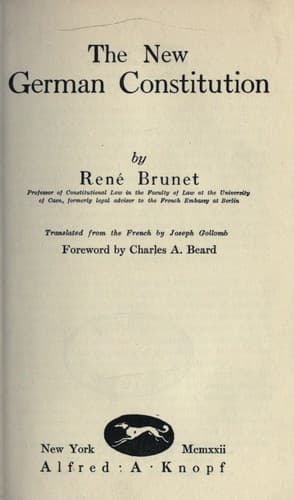
Germany -- Politics and government -- 1918-1933; Germany. Verfassung (1919)
Nothing systematic, however, has as yet been achieved. The ground is
new. Surprised by the Revolution, the theoreticians of new systems have
not yet fixed their schemes nor elaborated complete and coherent plans.
On the other hand, the majority of the National Assembly is formed by a
coalition of parties whose economic conceptions differ still more than
do their political conceptions. This lack of definiteness and these
differences endanger all effective realization of a solution. But the
necessity of reforms has made itself imperatively felt and economic
difficulties are so grave and menacing that they cannot wait indefinitely
for solution. Further, there are very many people who are restive and
who do not hesitate to resort to general strikes and even to revolts,
when governments hesitate too long in effecting a reform from which they
hope an amelioration of their lot. That is why one will look in vain for
a plan as a whole or a logical order in the provisions we are about to
study. Most of them were adopted by an assembly uncertain of the work it
should do, one which went about its tasks most hurriedly and obeyed the
pressure of external forces more powerful than itself.
SECTION I
THE ECONOMIC CONSTITUTION
The Economic Constitution rests wholly on the idea of the Councils. It
is recalled[57] that the system of the Councils, even under the parity
principle which the supporters of the Vocational Parliament wished to
give it, was left out of the political Constitution but is included in
the Economic Constitution, for which it forms the framework.
1.--THE “ANCHORAGE” OF THE COUNCILS IN THE CONSTITUTION.
Before the Revolution, said the Socialists and Trade Unionists, there
was in Germany neither political autonomy nor economic autonomy. Just
as in their political life the people were governed by a coterie of
junkers and bureaucrats, so in their economic life the people were
under the absolute domination of the entrepreneur. This autocracy of the
capitalists expressed itself legally in the fact that the conditions of
work were fixed solely by the employers. The omnipotence of the latter
was, however, modified by the collective bargains concluded between them
and the trade unions. While it is true that these agreements or bargains
did not have legal guarantees, nevertheless thanks to the existence
of workingmen’s organizations there was instituted by means of these
agreements a contractual and coequal workingmen’s right.
The Revolution of 1918 introduced in Germany political democracy. The
republican government in its establishment has even taken several steps
along the road of economic democracy. Reforms, such as the granting of
complete liberty of organization, the abolition of ordinances on wages
and exceptional laws against agricultural labourers, and the protection
of workers and salaried employés against arbitrary discharge, certainly
mark interesting progress.
Public-domain text, read in full here on John Shaqi.
Reviews
Reviews
No reviews yet
Be the first to share your thoughts on this work.
Elsewhere in the archive
Join the Discussion
Join the discussion
Sign in to leave a comment or review.
Sign InorCreate an account