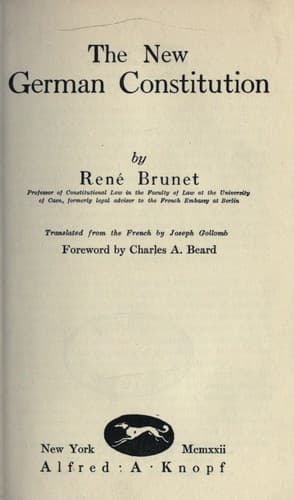
Germany -- Politics and government -- 1918-1933; Germany. Verfassung (1919)
In addition on December 23, 1918, the Commissars of the People signed
a decree “on collective agreements, workers and employers committees,
and the arbitration of labour disputes.” This decree[59] maintained
the committees which were developed during the war by virtue of the
law for patriotic service, and increased their powers. Here, too, the
whole mechanism rested on the parity principle. According to this
decree, committees of workers and employers had to be organized in all
industries, in all the administrative bodies and in all offices where
there were at least twenty labourers or employés. These had as their
mission the protection of the economic interests of labourers and
employés against employers in the factories, administrative bodies and
offices. The committees had to supervise in co-operation with the bosses
the carrying out of the various provisions in the collective contracts.
In factories where there was no collective contract the committees were
supposed to co-operate in the regulation of wages and other conditions
of labour in agreement with the economic representatives of the workers
and employés. It was their task, in addition, to maintain good relations
among the workers, as well as between the workers and employers.
It would seem that an evolution thus commenced could have continued
normally and without difficulty, and that economic and social problems
raised by the reorganization of Germany could thereafter be regulated by
the _Arbeitsgemeinschaften_; that is to say, by direct agreement between
employers associations and labour unions. But the problem was peculiarly
complicated by the introduction and rapid diffusion in Germany of Russian
revolutionary ideas. The Soviet differs essentially from the committee
above described. Whereas in the latter employers and employés are placed
on terms of equality and the committee itself becomes a purely economic
institution, the Soviet, according to the Russian conception, is a
political organization, whose purpose is to eliminate the employers and
to establish the dictatorship of the proletariat. The Soviet must have in
its hands all the political and economic power of the State.
Public-domain text, read in full here on John Shaqi.
Reviews
Reviews
No reviews yet
Be the first to share your thoughts on this work.
Elsewhere in the archive
Join the Discussion
Join the discussion
Sign in to leave a comment or review.
Sign InorCreate an account