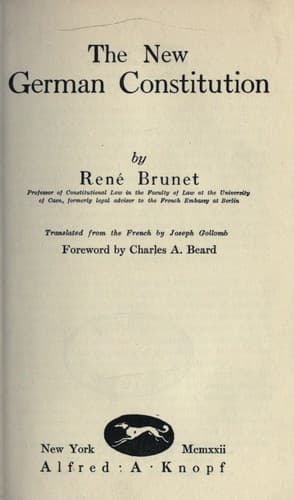
Germany -- Politics and government -- 1918-1933; Germany. Verfassung (1919)
As to this conception of the political omnipotence of the Council, we
have seen that powerful opposition ensued on the morrow of the Revolution
and that in January, 1919, the Social Democrats remained in full control
of power after having eliminated the Independents. We know that this
struggle continued, however, and it will be recalled what organizations
the Independents provided for and wished to institute in order to assure
to the Workers Councils the political sovereignty they claim. Parallel to
the political struggle between the Social Democrats and the Independents,
there developed another, on the economic field, between the Trade Unions
and the Councils, which found themselves in conflict as much over
what reforms should be demanded by the working class as over the rôle
these two groupings should respectively retain in the struggle for the
recognition of their claims.
The Trade Unions declared themselves satisfied with the agreement they
had concluded with the employers, as well as with the decree of December
23, 1918, which Legien, President of the General Confederation of
Labour, called “The Great Charter of Labour.” They were convinced that
thereafter there was nothing more to do but to wait for time to develop
logically and peacefully the rôle of the _Arbeitsgemeinschaften_ and of
the Committees provided for by the decree of 1918. _They did not believe
that in this evolution there was any room for Councils._ It was they,
the Trades Unions, that had theretofore been the only ones to occupy
themselves with economic questions, and they did not propose to permit
special groups, operating in isolated factories, to deprive them of
their traditional mission. Legien in particular did not want to hear any
talk of the Councils. They did not seem to him to be able to “incorporate
themselves in the actual hierarchy of the organizations and agencies
of the workers.” He protested against any concession to the system of
Councils, and declared that the only organisms in position to defend the
economic interests of the working class, were the Trades Unions.
Public-domain text, read in full here on John Shaqi.
Reviews
Reviews
No reviews yet
Be the first to share your thoughts on this work.
Elsewhere in the archive
Join the Discussion
Join the discussion
Sign in to leave a comment or review.
Sign InorCreate an account