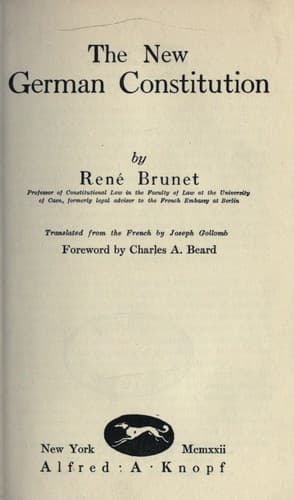
Germany -- Politics and government -- 1918-1933; Germany. Verfassung (1919)
The Economic Councils are organized according to a geographical
division. They consist of District Economic Councils and the National
Economic Council. The former consist of the union of District Workers
Councils with the corresponding representatives of the employers and
other interested classes of the population. The National Economic
Council consists of the union of the National Workers Council with the
corresponding representatives of the employers and other “interested
classes of the population.” The Constitution does not state precisely
what is to be understood by this last expression. In the Constitutional
Committee it was unanimously agreed that the consumers shall be
particularly represented in the Economic Councils. The creation of these
Councils is obligatory and legislators are bound by the Constitution to
enact the necessary laws to this effect.
In addition there may be created “autonomous bodies” (Article 156, par.
2) the administration of which is incumbent upon Economic Councils
organized not by regions but by industries. Unlike the regional Economic
Councils, the creation of these autonomous bodies is only optional; they
must be organized, says the Constitution, “in case of urgent necessity.”
The Constitution specifies with a little more detail than for the Workers
Councils, the powers of the future Economic Councils. These have for
their purpose, in addition to general economic duties, _to co-operate
in the execution of socialization laws_. In addition the Economic
Councils of the autonomous bodies are charged with the administration of
enterprises placed under the economic collectivity, such as coal, potash,
etc.[62]
Finally, the National Economic Council must have certain political
functions, and thereby the Constitution makes concession to the
supporters of the institution of an Economic Parliament. The solution
adopted constitutes a middle ground between the views held by the latter
and those of the partisans of a purely formal democracy. It gives to the
National Economic Council a certain political influence, but it does not
accord it absolutely any power of execution. It has the right to be heard
on all bills of social and economic character before they are presented
to the Reichstag by the Cabinet. It has, in addition, the right itself to
propose laws on social and economic matters, and the Cabinet is obliged,
even if it does not approve of these projects, to take them before the
Reichstag. It may only present its own point of view as opposed to that
of the Economic Council. Finally, the latter may send a representative
from among its members to present its proposal before the Reichstag. The
situation of the Economic Council is, on the whole, on the social and
economic field very analogous to that of the Reichsrat.
Public-domain text, read in full here on John Shaqi.
Reviews
Reviews
No reviews yet
Be the first to share your thoughts on this work.
Elsewhere in the archive
Join the Discussion
Join the discussion
Sign in to leave a comment or review.
Sign InorCreate an account