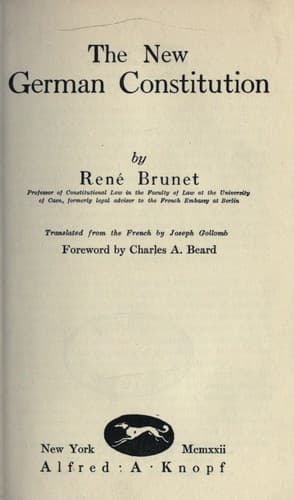
Germany -- Politics and government -- 1918-1933; Germany. Verfassung (1919)
The employers recognized that it was necessary to institute workers
representation in each industry and enterprise, and they accepted
the creation of the Councils, in which both employers and workers
would be represented, which would discuss questions of work and wage,
which would supervise the execution of collective bargains and which
would serve as an intermediary between the workers and the bosses.
But they energetically rejected all measures that, under more or less
roundabout devices, tended to recognize for the workers any right of
control whatever over production or the management of enterprises,
since merchants and manufacturers must above all have freedom of
operation. They protested energetically against all provisions that gave
the Councils the right to intervene in the direction of business, in
questions of hiring and discharging; just as they rejected the proposals
that the workers be allowed to participate in the consideration of new
technical methods, and that they, the employers, must submit their
balance sheets to the workers, reveal the amounts of their profits or
their losses and admit workers as members in the Administrative Council.
The supporters of the pure doctrine of the Councils, on the other hand,
criticized the Cabinet’s proposal for the opposite reason, because it
did not organize the real workers representation, but only Councils in
which the employers and the workers have the same right. It is impossible
to conciliate labour and capital, said they; for, the co-operation of
these two must inevitably end in the domination, by the employers, of the
workers. The Councils must be made up exclusively of workers who would
have an absolute right to control production. The powers given by the
bill to the Councils were illusory; they would be only petty unions. The
regulation of production would remain intact as before. These Councils
would be allowed to examine once a year the balance sheets of each
establishment, but they could not control the direction of its business,
its purchases, its selling or its profits. The only real advantage would
consist of being able to discuss the questions of hiring and discharging.
Thus attacked and criticized the bill, after the most impassioned
discussion,[63] after many important alterations, was finally adopted on
January 19, by a vote of 213 to 64. This is the law of February 4, 1920.
* * * * *
Public-domain text, read in full here on John Shaqi.
Reviews
Reviews
No reviews yet
Be the first to share your thoughts on this work.
Elsewhere in the archive
Join the Discussion
Join the discussion
Sign in to leave a comment or review.
Sign InorCreate an account