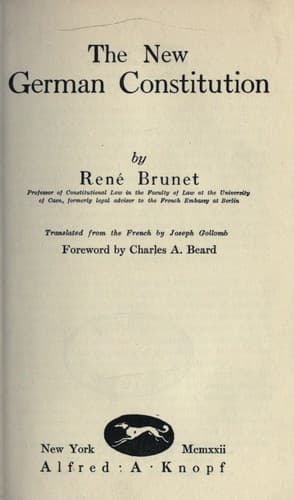
Germany -- Politics and government -- 1918-1933; Germany. Verfassung (1919)
II.--The organization of the Factory Workers Councils must be supple
enough to permit them to fulfil their mission, whatever the importance
or the form of the factory may be. They must be neither too small nor
too cumbersome; they must comprise both employers and employés; each of
these groups must be in position to defend its particular interests; the
electoral right must be wholly democratic and minorities must be insured
representation, which imposes the obligation of establishing proportional
representation; those delegated must always be guided by their duties as
representatives. As a consequence of the last, it must be provided that
the assembly of electors be enabled to withdraw its support from its
representatives and to recall them. The greater part of these conditions
was realized by the law of February 4.
The forms that the Factory Workers Councils may assume are extremely
diversified.
There is first of all the “Factory Workers Council,” properly so-called,
which exists in every industrial or commercial unit and in all the
public and private administrations where there are at least twenty
workers.
The wage-worker members of the Factory Workers Council constitute a
“Workers Council” and the salaried employé members make up an “Employé
Council.” If the Factory Workers Council has more than nine members
it elects according to the principles of proportional representation
a “Factory Committee” of five members. If the Factory Workers Council
comprises both representatives of workers and of employés, each of these
two groups must be represented in the Factory Committee.
A “General Factory Workers Council” must be created for enterprises of
the same kind situated in the same locality or in adjoining localities
and belonging to the same owners, if the Factory Workers Council in each
plant so decide. This organization may either remain in juxtaposition
with the Factory Workers Councils of the different plants, or it may
replace them. In that case it functions as a common Factory Workers
Council.
A “shop chairman” must be elected in the place of a Factory Workers
Council in establishments employing less than twenty workers, of whom at
least five must be electors.
There is finally a “Factory Assembly” composed of all the regular
employés of the factory. It is convened by the president of the Factory
Council. He must convoke it if the employer or at least one-quarter of
the workers demand it.
* * * * *
III.--The powers of the Factory Workers Councils are two kinds;
social and economic. _With one or two exceptions they are both purely
deliberative in character._
* * * * *
SOCIAL POWERS:
(A) _Conditions of Work_.
Public-domain text, read in full here on John Shaqi.
Reviews
Reviews
No reviews yet
Be the first to share your thoughts on this work.
Elsewhere in the archive
Join the Discussion
Join the discussion
Sign in to leave a comment or review.
Sign InorCreate an account