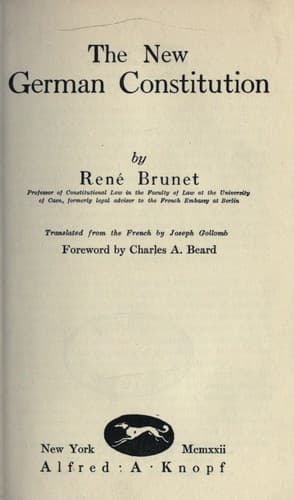
Germany -- Politics and government -- 1918-1933; Germany. Verfassung (1919)
(1) The Factory Workers Council supervises the execution of legal
decrees, of collective bargains and of arbitration decisions in favour
of the workers. The regulation of the conditions of work by collective
bargaining remains the essential purpose of the Vocational Unions.
The Factory Workers Councils cannot and must not replace this general
trade union agreement by a regulation which would intervene between the
workers of any single factory and the management of that factory, for
the conditions of labour, particularly wage scales, must be fixed not
simply according to the conditions prevailing in any single factory, but
according to the general situation of the industry. On the other hand,
the Factory Workers Councils must see to it that the conditions of work
agreed to between the manufacturer’s union and the labour organizations
are strictly carried out, and must adjust any difficulties that may arise
in their application. Each Council must perform the same function in
regard to the execution of arbitration decisions and the carrying out
of legislative regulatory provisions relative to the condition of the
workers.
(2) The Factory Workers Councils co-operate in the fixing of wages
and other conditions of work, when these questions are not settled by
collective agreement. But it is understood that, even in such a case,
the Factory Workers Councils must act in accord with the Trade Unions
concerned.
(3) They co-operate with the employer in the adoption of rules for the
factory within the framework of the collective bargains in operation.
(4) They examine the questions of pensions for wounded veterans and
compensation for those hurt in course of work.
Public-domain text, read in full here on John Shaqi.
Reviews
Reviews
No reviews yet
Be the first to share your thoughts on this work.
Elsewhere in the archive
Join the Discussion
Join the discussion
Sign in to leave a comment or review.
Sign InorCreate an account