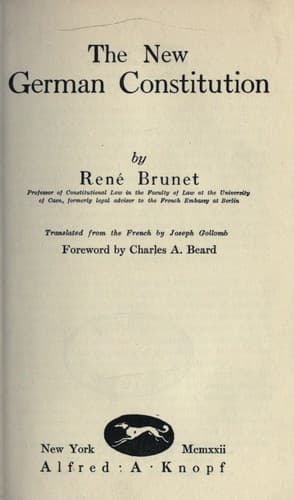
Germany -- Politics and government -- 1918-1933; Germany. Verfassung (1919)
(2) In the factories that have Administrative Councils,[64] the
wage-earners and salaried employés are represented on these councils by
one or two delegates. This representation of workers on Administrative
Councils has aroused among the employers the liveliest opposition.
The Cabinet’s project provided that the worker representatives have
the same rights and duties as the other members of the Administrative
Councils. But the National Assembly has not followed the Cabinet on this
point and has limited the power of the workers’ representatives in the
Administrative Council to the mere statement of the interests and claims
of the workers, and to the execution of their votes and wishes concerning
the organization of the factory. In addition this representation must
be regulated by a special law, and, until such a law is passed, that of
February 4 confines itself to prescribing that the representatives of the
workers have a seat and voice in all the meetings of the Administrative
Council, but that they receive no remuneration other than the pay for the
time of attendance at the meetings. They are obliged to keep confidential
what they learn at the meetings of the Council. The underlying spirit
intended for the workers’ representation in the Administrative Council
is indicated as follows: “The granting of so extensive a power, changing
the right of co-deliberation generally accorded to the working class
into a right of codecision, is proposed in the conviction that nothing
is better calculated to increase the love of work, the sentiment of
responsibility and the output of industries than the right accorded to
workers to co-operate under their own responsibility in the supreme
direction of the factories.”
One cannot conclude the study of the economic powers of the Factory
Workers Councils without saying a word on the question of the
co-operation of these Councils in the socialization process. The
supporters of the theory of Councils have always forcefully insisted on
this co-operation to justify the necessity of giving the maximum power
possible to the Factory Workers Council. But the law of February 4 does
not grant these councils in economic matters anything but powers of
deliberation, hardly even conceding them the right of decision; nor does
it give them any privilege other than that of supporting and helping
their employers in the achievement of the factory’s purposes. Thereby
is denied all action on the part of the Factory Workers Councils that
might directly influence the socialization of the factory itself. The
law of February 4 seems to take the point of view opposed to that of
socialization.
Public-domain text, read in full here on John Shaqi.
Reviews
Reviews
No reviews yet
Be the first to share your thoughts on this work.
Elsewhere in the archive
Join the Discussion
Join the discussion
Sign in to leave a comment or review.
Sign InorCreate an account