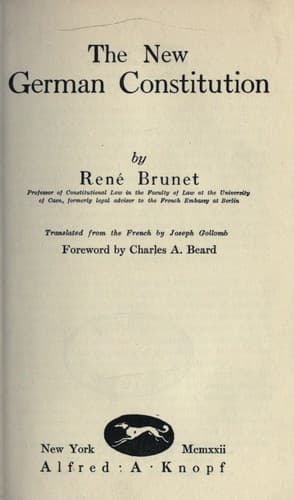
Germany -- Politics and government -- 1918-1933; Germany. Verfassung (1919)
The task which the Factory Workers Councils must accomplish and which
must serve as the basis of all their future activity, is to achieve a
unity of front of the whole working class. The Trade Unions have not yet
brought themselves to take the initiative in this fundamental reform.
At the present time workers are still scattered among approximately
fifty Trades Unions, which are divided still further into a number of
sections and branches. There is an inextricable network of collective
contracts, “tariffs,” and wage agreements down to the smallest labour
group, representing a great amount of work; but this cannot in the least
ameliorate the economic condition of the working class.
One thing must immediately be abolished, the _Arbeitsgemeinschaft_,
because it is contrary to the doctrine of the class struggle, and
because, under the pretext of co-operation, it insures the domination of
the capitalist over the worker.
As for the Trades Unions, the champions of the Factory Workers Council
recognize that the latter, although working on a different plan,
must remain in intimate contact with the former. But there is an
indispensable reform to be realized. Organization by trades must be
replaced by organization by industries or factories. In other words,
all the vocations functioning at the same time in the same industry
must be grouped within the same organization. In still other words,
the separation of wage-earners associations from the associations of
salaried employés must be done away with. On the contrary, all manual
and intellectual workers of the same industry must join together and
consecrate all their efforts to a common end.
Finally, declared the partisans of the Councils, the Factory Workers
Councils cannot remain isolated in the various separate industries. They
can only fulfil their function if they unite in district assemblies and
organize in such a way as to create a “Central Organ of the Factory
Workers Councils,” which will direct the activity of all the Factory
Workers Councils of Germany.
These arguments were not without effect on the Trades Union leaders.
They still maintained, naturally, the principle that the Factory Workers
Councils must enter into the Trade Union organization and that they must
remain an organ of the latter. But they declared themselves ready to
accept a great part of the reforms demanded by their critics.
Public-domain text, read in full here on John Shaqi.
Reviews
Reviews
No reviews yet
Be the first to share your thoughts on this work.
Elsewhere in the archive
Join the Discussion
Join the discussion
Sign in to leave a comment or review.
Sign InorCreate an account