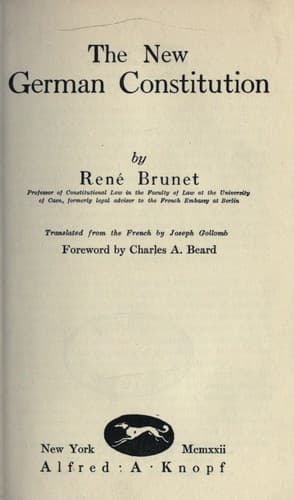
Germany -- Politics and government -- 1918-1933; Germany. Verfassung (1919)
It does not deserve this name, for it has no power of decision. It
is purely and simply a technical Council that advises the Cabinet on
principal economic questions. It differs from ordinary technical Councils
in that instead of being appointed most of its members are elected. One
cannot therefore criticize it from the point of view of formal democracy,
in the way that any parliament composed according to the parity principle
can be criticized, viz., that each employer-member represents much fewer
electors than the worker-members. As it is here a matter of a council
of experts, the most important thing was to gather the best qualified
authorities of the whole country. It is evident, therefore, that in the
present state of affairs such authorities are found much more easily
among employers than among workers. The relative proportion of these two
elements within the Provisional Economic Council matters little since
decision lies exclusively with the assembly elected by universal suffrage.
Meanwhile, however, the importance of the services that the Economic
Council can be called upon to render must not be underestimated. It
is undeniable that, as at present composed, it has gathered together
nearly all the men considered in Germany to-day as the most experienced
and trained authorities in economic matters. It must not be lost sight
of also that a great number of these men, aside from their individual
importance, have behind them the support of the whole force of the
extremely powerful vocational and economic associations by which they
were elected.
One immediate danger menaces the Economic Council. It is that the men
who compose it will let themselves be guided on the technical questions
they are to examine by party considerations. It may be divided--as
is natural--into groups of employers, groups of workers, groups of
agriculturalists, industrialists, and merchants. If it turns out to be
an assembly of conservatives, democrats, Catholics and socialists, it is
doomed to sterility.
If, however, the Economic Council avoids this danger it will render,
first of all, the service of clarifying the political atmosphere itself.
The members will defend very legitimately only the interests by which
they were charged with representation. In this way economic groups will
not need to act indirectly through the intermediate agency of political
representatives. They will be able to express their point of view clearly
and support their interests directly. The political parties, too, will
gain thereby; for they will be freed of all considerations of interest
and they will no longer have to complicate technical problems by imposing
on them their general political conceptions. As for the authority that
will accrue to the Economic Council, it depends entirely on itself
whether it will be nullified or preponderant, and its future lies in its
own hands.
Public-domain text, read in full here on John Shaqi.
Reviews
Reviews
No reviews yet
Be the first to share your thoughts on this work.
Elsewhere in the archive
Join the Discussion
Join the discussion
Sign in to leave a comment or review.
Sign InorCreate an account