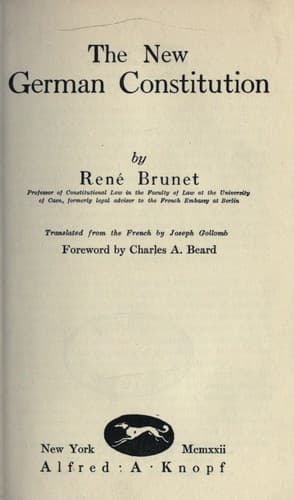
Germany -- Politics and government -- 1918-1933; Germany. Verfassung (1919)
Former Under-Secretary of State, von Delbrück said before the National
Assembly--speaking, it is true, of the Economic Council to be organized
by the Constitution, but the Provisional Economic Council is nevertheless
its precursor--that the Economic Council is without doubt, by the side of
the Reichstag and the Reichsrat, a third legislative assembly. For such
an assembly, “called upon to deliberate on the most important questions
in the national life, will necessarily have a natural tendency to enlarge
its powers. We are undoubtedly on the eve of a period in which the
Reichstag and the Reichsrat will be considered as one side of a balance,
and the Economic Council as the other. Behold in this a wholly new
political evolution. There will come a day when the Economic Council will
seek to become the heir of the Reichsrat and to take its place.”
Will this prediction be realized? It will if the Economic Council is able
to render the government and the people the services they expect of it.
It will not if it does not deserve to be heard by them and does not know
how to make itself heard.
SECTION II
SOCIALIZATION
In order to reconstruct in Germany the public and private economy
destroyed by the war and the revolution, it is not enough to give the
producers a special right to co-operate in the regulation of economic
questions; nor to recognize particularly for the working class the right
of co-deliberation in the determination of these matters. It is hoped
that such measures will increase production. But it is also necessary
that no part of production be lost and that all of it be utilized to the
utmost for the community. One is thus led to inquire whether the system
of production and the distribution of wealth, such as prevails under a
capitalist régime, is capable even if improved, of attaining such an
end; whether it were not better to substitute a new system, socialist or
not, giving the utmost guarantee that production will benefit the entire
community.
We must inquire what attitude the Constituent Assembly took on this
question and what solution it adopted.
1.--THE PROBLEM OF SOCIALIZATION.
On the morrow of the Revolution, power passed entirely into the hands
of socialists, that is to say, by definition, men whose programme may
be summed up in these words: the abolition of private property and the
taking over by the state of all the means of capitalist production.
The Independents undoubtedly would have set about at once the task of
realizing this programme. But we have seen that they had but a brief
period of power; and the Social Democrats seemed less in a hurry to keep
their promises.
Public-domain text, read in full here on John Shaqi.
Reviews
Reviews
No reviews yet
Be the first to share your thoughts on this work.
Elsewhere in the archive
Join the Discussion
Join the discussion
Sign in to leave a comment or review.
Sign InorCreate an account