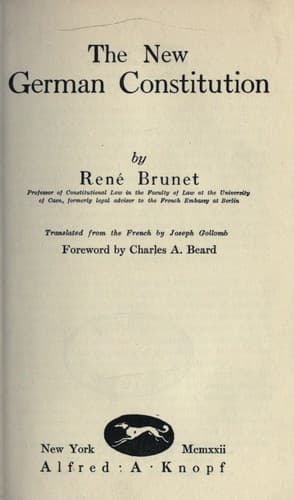
Germany -- Politics and government -- 1918-1933; Germany. Verfassung (1919)
For the moment the political revolution was enough to absorb all their
activity, and they postponed the economic revolution. They declared
that an industry cannot be socialized until it is “ripe” for such a
measure. But, they further declared, this maturity cannot be suddenly
effected by a vote of Parliament or even by the decision of the majority
of the people. It is the product of a slow social development, which
may find its expression in the vote of a majority, but which cannot be
thereby hastened. To tell the truth, the Social Democrats, whom events
had placed with their back to the wall, perceived how difficult it is
to put into practice the vague theories with which they had heretofore
contented themselves. Not only did they realize that the solution of
economic questions raised by socialization is extremely difficult, but
they became also convinced that it was necessary first to consolidate
some of the elements of German economic life that had survived the war
and its unhappy conclusion before proceeding to experiments which might
accomplish their ruin. They resolved therefore to study the problems of
socialization more deeply before passing to its realization. For this
purpose they created, November, 1918, a “Committee on Socialization”
which was not to be an official organ but a free scientific committee
charged with the drawing up of reports and proposals on the question of
socialization. It consisted of eleven members with Kautsky as chairman.
But the impatience of the masses did not give the Socialist Cabinet the
respite they required. The people, who for years had been promised the
abolition of private capitalist property, and who saw in the realization
of the Socialist programme the end of the miserable situation into
which the war and the revolution had plunged them, demanded immediate
measures. The general strike which broke out in Berlin in March,
1919, and which, as we have seen, prompted the Cabinet to promise the
“anchorage” of the Councils in the Constitution, also pushed it to
prepare in haste two projects of law--one on socialization, the other
on the regulation of the coal industry, the two projects being adopted
within a few days by the National Assembly. The two laws carried the date
of March 23, 1919. The first is what is called in Germany a “blanket
law” or a “skeleton law.” It indicates the different forms according to
which socialization of private enterprises may become operative, and the
conditions in which these enterprises, once socialized, may be exploited.
The second makes immediate application of these principles to the coal
industry. In addition another law voted several days later, April 29,
1919, regulated according to the same principles the potash industry.
Whereupon the members of the Committee on Socialization, who complained
of having their work constantly impeded by the Cabinet, and their
recommendations remaining unheeded, handed in their resignations on April
7, 1919.
Public-domain text, read in full here on John Shaqi.
Reviews
Reviews
No reviews yet
Be the first to share your thoughts on this work.
Elsewhere in the archive
Join the Discussion
Join the discussion
Sign in to leave a comment or review.
Sign InorCreate an account