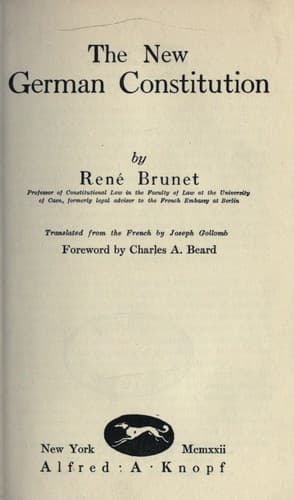
Germany -- Politics and government -- 1918-1933; Germany. Verfassung (1919)
By these last two measures will be realized what the supporters of this
system call a “progressive mediatization of capital.”
(5) There will be created funds of several billions of marks which will
be administered by an office acting in close relation with the vocational
economic organization and designed to procure employment for German
workers.
(6) The cost of necessities which Germany must import exceeds greatly
the cost of domestic commodities. This circumstance compels the increase
of wages, which in turn causes the cost of living to rise and lowers the
value of money. To counteract this part of all wages must be distributed
hereafter in provisions, clothes, etc. Credits will be opened by
financiers and by the State.
(7) Temporarily the right to strike in certain industries vital to the
German economy will be restricted. The right to stop work will have to be
voted by nine-tenths of those employed in that industry.
(8) To realize this programme the number of Ministers who will occupy
themselves with economic questions will be reduced to three. They will
constitute within the Cabinet an “Economic Committee,” whose directions
will have to be followed absolutely by the political Ministers.
On the whole this project aimed at the realization of a state
intermediate between capitalism and socialism.
Defended only among the socialists by a small group of doctrinaires, this
project had against it at the same time the Independents, the bourgeois
parties and the Social Democrats. The Independents opposed it because it
permitted capital to survive. The bourgeois parties opposed it because
the supervised economy prevented the free play of economic factors
and paralyzed initiative. The Social Democrats opposed it for fear of
dissatisfying the Centre and the Democrats, of whom they had need to
maintain themselves in power. Particularly opposed to Wissel’s project
were the Trade Union conceptions supported in the Cabinet by the Minister
of Food Supply, Robert Schmidt. He presented a counter-project which
embodied the argument which the Socialists of the government opposed to
the theoreticians of socialism. The work of socialization, said they,
must be undertaken but slowly and the socialization of an industry must
wait until that industry is sufficiently matured. This last conception
prevailed and in July, 1919, Wissel resigned. Thereupon the offices of
the Minister of Public Economy and that of Food Supply were merged and
Robert Schmidt given the unified post.
It was to be expected, therefore, that the process of socialization would
be considerably slowed up. In fact, the Constitution of the month of
August confined itself to specifying and enlarging in several respects
the principles of the law of socialization of March 23; and for several
months there was only one law enacted along these lines, that of December
31, 1919, on the socialization of electricity.
Public-domain text, read in full here on John Shaqi.
Reviews
Reviews
No reviews yet
Be the first to share your thoughts on this work.
Elsewhere in the archive
Join the Discussion
Join the discussion
Sign in to leave a comment or review.
Sign InorCreate an account