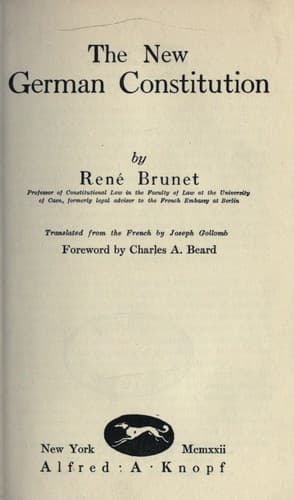
Germany -- Politics and government -- 1918-1933; Germany. Verfassung (1919)
But once more the people intervened. It may be recalled that one of the
“Eight Points” of the agreement imposed on the Cabinet by the Trade
Unions after the _coup d’état_ by Kapp, provided that the Committee on
Socialization be at once reconvened, that representatives of vocational
associations be added to it, that new industries be socialized and that
the socialization of industries already decreed be enforced.
In conformity with these engagements, the Cabinet in the beginning of
May, 1920, submitted to the Reichstag a project of law that provided for
the municipalization of a certain number of industrial enterprises, and
reconvened the Committee on Socialization. The members of this committee,
who were authorized to add to their number new colleagues on the
condition that the total number of the members should not exceed thirty,
were given a double mission. First they were to study and clarify the
fundamental principles of socialism, for the purpose of determining the
general lines along which the capitalist system should be transformed.
Then they were to submit concrete and immediate proposals, which,
inspired by the laws of collective economy, would permit the commonwealth
to utilize directly the natural resources and the sources of power. The
committee had also to study how the industries already socialized were
functioning, what results had been attained and to propose, if necessary,
all needful changes.
2.--THE COLLECTIVE ECONOMY.
All these labours, all these investigations, all these discussions of the
problem of socialization had one result. They have shown how confused,
even among the socialists, is the concept of socialism; that behind the
same word may hide two economic systems extremely different, and that a
whole series of almost imperceptible gradations may exist between the
capitalist system and complete socialism.
The Constitution raises the following principle: Economic organization
must cease to be dominated by considerations of private interests in
order that hereafter it may be inspired exclusively by considerations of
public interests. Private interests must be subordinated to collective
interests. The present economic régime, based on private ownership,
must be substituted by a new régime based on collective ownership
(Gemeinwirtschaft). What is understood by this?
Public-domain text, read in full here on John Shaqi.
Reviews
Reviews
No reviews yet
Be the first to share your thoughts on this work.
Elsewhere in the archive
Join the Discussion
Join the discussion
Sign in to leave a comment or review.
Sign InorCreate an account