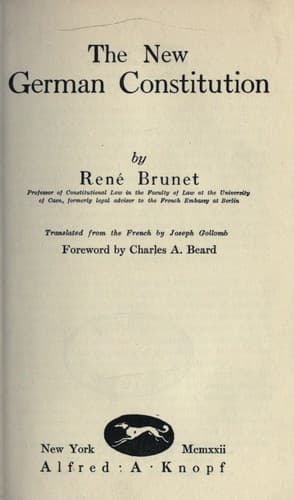
Germany -- Politics and government -- 1918-1933; Germany. Verfassung (1919)
_The Colliers Associations_ supervise the application of the decrees
issued by the National Coal Council and by the National Coal Association,
and, within the framework of these decrees, regulate the production,
utilization and consumption on the part of their members. They,
themselves, sell the fuel which should be put at their disposal by their
members, on the account of the latter. The powers of the Association of
Coal-gas Manufacturers are similar.
The mining companies may raise claims and protests against the
regulations of the Associations of which they are members, appealing
to the National Coal Association and beyond that to the National Coal
Council.
If any measure on the part of the National Coal Council, the National
Coal Association, or of the Colliers Associations violates any vested
right, the individual or the association injured is entitled to suitable
indemnity. This indemnity may be sued for before ordinary tribunals.
The powers of the Reich, the States, and the municipalities are fixed by
the decree of August, 1919, as follows:
The Reich, through the intermediacy of the Minister of Public Economy,
exercises general control over the fuel economy. The Minister may
in particular lower the price of coal fixed by the National Coal
Association. He may also organize a representation of fuel consumers, a
representation with authority to fix the retail price of coal. The cost
incurred by the Reich in the execution of the law on the regulation of
coal, up to a minimum of 200,000 marks per year, must be borne by the
National Coal Association.
The States represented by the Committee on Commerce and Industry in the
Reichsrat are authorized to participate in the deliberations of the
National Coal Council and its committees, but only with consultative
powers. Fiscal authorities are authorized to demand information of the
National Coal Council of the Reich and of its committees as well as of
the National Coal Associations and of the Colliers Associations.
Municipalities of at least 10,000 inhabitants and groups and Unions of
Municipalities, after having heard the claims of dealers and consumers,
and guided by the wholesale price of coal fixed by the National Coal
Association, are themselves empowered to fix the retail price within
their territories.
* * * * *
II.--The regulation above described was far from giving complete
satisfaction. It has been attacked both by the consumers and the
socialists. The latter criticize it as not having gone far enough along
the road of nationalization. The former, on the other hand, complain that
prices are fixed by an Assembly in which coal owners form a very great
majority (The National Coal Association), and that the other interests
are not able to make themselves sufficiently heard. The result of this
system is that the coal producers always come to agreement to the
detriment of the consumers and constantly increase the price of coal.
Public-domain text, read in full here on John Shaqi.
Reviews
Reviews
No reviews yet
Be the first to share your thoughts on this work.
Elsewhere in the archive
Join the Discussion
Join the discussion
Sign in to leave a comment or review.
Sign InorCreate an account