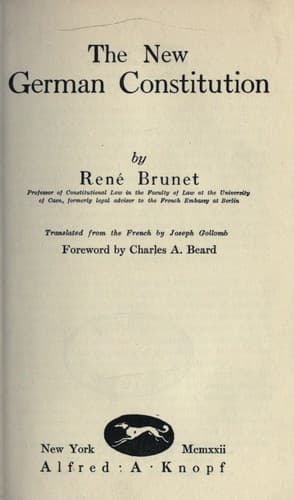
Germany -- Politics and government -- 1918-1933; Germany. Verfassung (1919)
_The National Coal Council_ is composed of sixty members--representatives
of the states, of mine owners organizations, wage-earners, office
workers, consumers, etc.[70] It is convened as often as conditions demand
and at least once every six months. It must in addition be convened if
at least ten of its members or the Minister of Public Economy of the
Reich demand it. It decides by majority vote. It creates three technical
committees, The Economic Committee on Mining Construction, The Economic
Committee for the Utilization of Combustibles and The Social Committee
of the Mines. Each member of the National Coal Council must belong to a
committee. The cost of the administration of the National Coal Council
and of its committees is borne by the National Colliers Associations.
* * * * *
Each of these organs has its own special powers.
The National Coal Council directs the economy of combustibles, in which
is included importation and exportation, according to the principles
of collective economy under the supervision of the Reich. It must
approve the charters according to which the Colliers Associations and
the National Coal Association are organized. The National Coal Council
may decree general policies for the administration of combustibles, in
particular for the abolition of unproductive enterprises and for the
protection of consumers. It sees to it that the National Coal Association
and the technical committees of the Coal Council work according to the
same principles and in a coherent system. It may demand information
from any of the organs that participate in the fuel industry; and the
authorities and committees are obliged to give it any assistance it
demands. The technical committee collect all important data based on
practice and experience, study all matters that enter within their domain
and prepare decisions for the National Coal Council.
_The National Coal Association_ controls the application of the general
policies and decisions decreed by the National Coal Council and regulates
the details of the execution of these decrees. It must approve the
general conditions of the coal deliveries of the Colliers Association.
_It establishes and publishes the selling prices of fuel, taking into
account proposals made by unions and the interests of the consumers._ On
this point it must insure the same treatment for the consumers’ societies
as for the wholesalers, and see to it that each consumer, who takes at
least a full carload of coal at the mine or at the point of delivery,
shall obtain fuel under predetermined conditions for cash payment.
Finally, the National Coal Association has authority in questions of
import and export.
Public-domain text, read in full here on John Shaqi.
Reviews
Reviews
No reviews yet
Be the first to share your thoughts on this work.
Elsewhere in the archive
Join the Discussion
Join the discussion
Sign in to leave a comment or review.
Sign InorCreate an account