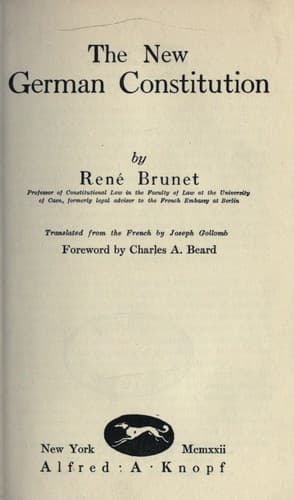
Germany -- Politics and government -- 1918-1933; Germany. Verfassung (1919)
The first, that of Lederer, signed by ten out of twenty-one members,
demanded _immediate expropriation and nationalization of all the mines_.
The owners of the mines would receive an indemnity in the form of bonds
bearing a fixed interest, and the ownership of these mines would be
transferred to an autonomous body, called “The German Coal Corporation.”
This corporation is to be governed by the National Coal Council, which
appoints a “directorate” to administer affairs. The right to appoint
industrial heads, as well as the responsibility for the technical
exploitation, passes to the National Coal Council and to the Directorate.
Bonuses for production are to be given to directors, salaried employés
and workers.
The authors of this proposition insist on the fact that they are not
instituting state socialism for mines with all its attendant fiscal and
bureaucratic dangers; and to emphasize what it is they are aiming at,
they propose that the mines now owned by the Reich and by the States be
taken away from them and transferred to the German Commonwealth of Coal.
Prices will be fixed by the Reich, to whose budgets will be accounted the
profits of the exploitation--and undoubtedly the losses.
The second proposition, that of Rathenau and signed by eleven members
out of twenty-one, does not go as far along the road of nationalization.
The present owners of mines, according to this plan, provisionally
retain their property, but their rights therein are strikingly reduced.
The distribution and the sale of products cease to be guaranteed by the
National Coal Association--which is, in fact, done away with--and are
given over to the National Coal Council and to a Directorate, four out
of five of whose members are elected by the Council; the fifth, the
President, is appointed by the Minister of Public Economy.
The principal innovation consists in this. Whereas formerly the sale of
coal was made on the basis of the individual exploitations, according
to this project every mine transfers to the National Coal Council its
whole output, and the net price is averaged according to the books. The
National Council, therefore, has a monopoly on the wholesale trade and it
fixes the selling prices. In addition to the net cost the Council credits
to the mine (1) the cost of delivery and the interest and amortization
of bonds of the enterprises; (2) the interest and amortization of new
investments; (3) the normal fixed interest on the operating capital
employed in the exploitations; (4) bonuses, fixed according to a
schedule, for the increase of output of each exploitation; or deductions
in case of decrease of output.
Public-domain text, read in full here on John Shaqi.
Reviews
Reviews
No reviews yet
Be the first to share your thoughts on this work.
Elsewhere in the archive
Join the Discussion
Join the discussion
Sign in to leave a comment or review.
Sign InorCreate an account