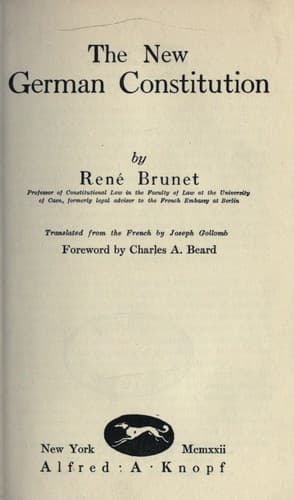
Germany -- Politics and government -- 1918-1933; Germany. Verfassung (1919)
The National Council may demand the inauguration of new projects, or
exploitations may propose improvements with the approval of the Council,
provided that either the Council or the entrepreneur furnishes the
necessary funds. Finally, in order to retain the free play of private
initiative, an entrepreneur may, even in spite of the National Council,
make investment but at his own risk and peril.
By these provisions the entrepreneur loses all interest in the increase
of the price of coal, for commerce in it and commercial profits are
denied to him. Also the fixing of high net prices does not serve him
in any way, since his books are supervised by the properly empowered
auditors of the National Council. The only way left him to make big
profits is to improve his exploitation in its economic and social
aspects. The interest or the profit which has hitherto ruled economy
is retained in form, but it can no longer work except in the common
interest. The situation of the manager will depend as to-day on an
objective economic success.
The Cabinet of the Reich announced its intention of soon submitting a
project of law which will adopt in outline the Rathenau proposition.
Already the mine owners are discussing in the press the question of
the “maturity” of the mines and the mode of calculating the cost of
production. But above private interest there is a collective interest and
the question will come up whether the system proposed by the Committee on
Socialization and the Cabinet does not incur the risk of becoming more
troublesome than profitable to the community itself.
CONCLUSION
We have analyzed in the preceding pages the principal provisions of the
German Constitution. There are in it a great number of other provisions,
which had to be omitted from this analysis deliberately, either because
they also occur in all the other Constitutions of the world, such as the
principle stated by Article 102, that judges are independent--provisions
which do not at all serve in characterizing the work of Weimar; or, on
the other hand, because they were dictated exclusively by the necessity
of solving problems created by the particular circumstances in the midst
of which the Reich found itself; such as the provisions of Article 88
and those following, dealing with the post, railroads, and navigable
waterways. These provisions present only a slight interest from the
general constitutional point of view.
Public-domain text, read in full here on John Shaqi.
Reviews
Reviews
No reviews yet
Be the first to share your thoughts on this work.
Elsewhere in the archive
Join the Discussion
Join the discussion
Sign in to leave a comment or review.
Sign InorCreate an account