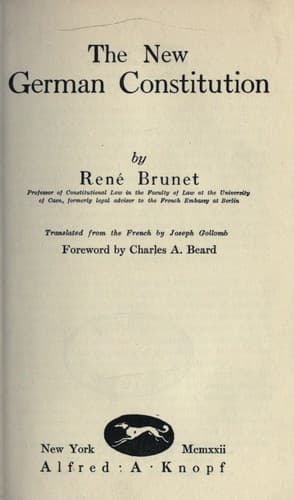
Germany -- Politics and government -- 1918-1933; Germany. Verfassung (1919)
Once more Prussia holds the fate of Germany in its hands. If, renouncing
the attitude which it has maintained since the Revolution, Prussia
permits a transformation of some of its provinces into states, or
if it accords them an autonomy so great that they will be in effect
assimilated into states, then the federalist or separatist tendencies
will probably lose much of their strength, and the unitarism desired by
the Constitution will be able to maintain itself and even to develop.
But if Prussia, relying on its strength and prestige, diminished though
they be, insists on keeping the other German states, willing or not, in a
Reich dominated by it, then it may be that the federalist or separatist
tendencies will prevail.
The political institutions of Germany are as strongly impregnated with
the _democratic idea_ as possible. The majority is sovereign. But
there are minorities, to the right and to the left, that aspire to
dictatorship. It seems little likely that another attempt like that of
Kapp and Lüttwitz will succeed any better than the last attempt--at least
unless a sudden and complete change in the political orientation of the
people takes place. On the other side, the Independents, for whom even
in Berlin a _coup d’état_ may be perhaps easy enough, know that they
would have against them the great majority of the German people, and
their leaders openly declare that their hour has not yet come. If in
the domain of democratic doctrine a change seems likely to come, it is
probable that it will appear in the form of a right expressly accorded to
economic associations or, in a still more general manner, to producers,
to exercise a special and direct influence on the government. If the
Provisional Economic Council succeeds, it is possible that Germany will
broaden the experiment and attempt a true Economic Parliament.
_Parliamentary government_ has been accepted but it is mistrusted.
There have also been introduced a whole series of measures such as
the referendum, initiative, the nomination and the impeachment of the
President by the people, which are not only logical applications of the
democratic principle, but which are also assurances against any possible
misdeeds of parliamentarism. This is a splendid proof of trust in
democracy. It is for the future to say whether it is justified.
Public-domain text, read in full here on John Shaqi.
Reviews
Reviews
No reviews yet
Be the first to share your thoughts on this work.
Elsewhere in the archive
Join the Discussion
Join the discussion
Sign in to leave a comment or review.
Sign InorCreate an account