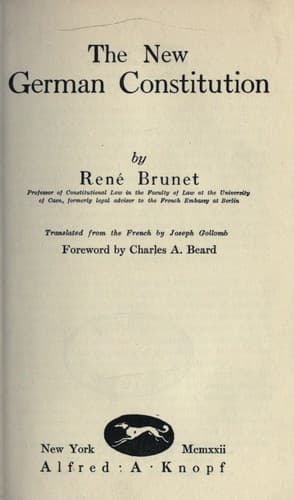
Germany -- Politics and government -- 1918-1933; Germany. Verfassung (1919)
We know the bases on which it is constructed; politically--unitarism,
parliamentary democracy, the republic; economically--the participation
of the working class in the management of industry, evolution toward the
nationalization of the industries most important in the national life.
The political institutions, under more or less different forms, have been
tested by other peoples, who have not complained of them. Will these
institutions, adapted as they have been, succeed equally for the German
people? The economic institutions are new. What will be their worth?
The question is serious; for in this edifice so logically constructed
all parts are mutually interdependent, and the whole will not endure
unless the parts are solid. The downfall of any of them will drag down
the others. Political institutions will not function unless economic
provisions assure industry and commerce sufficient prosperity. But
economic institutions will be swept away if the government is overwhelmed
and ceases to fulfil its mission.
* * * * *
The Constitution begins with making the Reich a state as unitary as
possible without completely suppressing every trace of the federal
régime. But there are strong centrifugal tendencies. In Prussia there
are several provinces that demand to be formed into distinct states.
Throughout the Reich there are several states that demand the return to
a purely federal régime, if not actually the complete separation from
the German Reich. Will these tendencies be strong enough to bring about
a relaxation of the unitary bond, if not actually the disintegration
of the Reich? We have already pointed out the difference, for example,
separating Catholic, peasant and conservative Bavaria from Protestant,
industrial and socialist Prussia. The States were able to endure without
much difficulty the hegemony of a victorious, powerful, prosperous
Prussia, a hegemony by which they profited. But the same States resent
the thought that a Prussia, which they hold responsible for the defeat
and which they now see much weakened, should want to keep them still
under its yoke and to attempt, under the pretext of unity, to absorb the
Reich. They feel this all the more strongly since the future is dark.
Prussia has been dangerously stricken and it may appear more advantageous
not to tie up too intimately their own interests with those of such a
state.
Public-domain text, read in full here on John Shaqi.
Reviews
Reviews
No reviews yet
Be the first to share your thoughts on this work.
Elsewhere in the archive
Join the Discussion
Join the discussion
Sign in to leave a comment or review.
Sign InorCreate an account