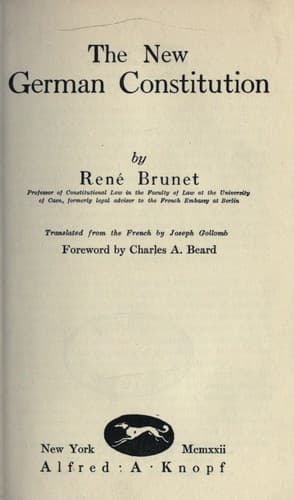
Germany -- Politics and government -- 1918-1933; Germany. Verfassung (1919)
The doctrine of the Councils leads naturally to _nationalization_.
For to confide the administration of the whole of an industry to
Economic Councils, in which the workers are represented by the side of
the employers and consumers, is to make a direct application of the
_Mitbestimmungsrecht_. But other considerations are also tending to
give this system a place of increasing importance. “The free play of
economic forces” is no longer being upheld. It is affirmed everywhere
that classic liberalism has had its day, and that in order to improve the
economic situation so extremely unfavourable in all the modern states,
it is not enough that things be allowed freely to take their course.
It is now thought that “let alone” leads to bankruptcy. One no longer
believes in the former principles that held as absolute the right to
private property, the right of work, liberty of commerce, and freedom of
contract. To-day these rights are held to be limited by the general good
and must be exercised by the individual in the interest of all.
As the question of principle seems to be settled the problem becomes
almost exclusively a practical one. A certain number of industries have
become more or less nationalized or even socialized and will become still
more so, their number also probably growing. The discussion now seems
to be only on the modes of application, on the degree of “maturity”
necessary; on whether this or that industry is or is not ripe; on the
mode of calculating the cost of exploitation; on bonuses for output,
etc., etc.
Like the idea of the Councils, this doctrine of nationalization seems to
gain more and more. What will come of it for Germany and for the States
that will follow this road? Are not these new formulas the ephemeral
result of the upheaval due to the war? Or will they, improved and tested
by practice, be definitely installed in the economic organization of all
modern peoples? To the countries that adopt them, will they bring ruin
or economic prosperity and social peace? On these matters, one can only
write interrogation marks. In any event, however, it is important to
follow the German experiment with the greatest possible interest.
GLOSSARY
German Translation
REICH Commonwealth
REICHS- of the Commonwealth, national
REICHSARBEITERRAT National Workers’ Council
REICHSGERICHT National Judicial Court
REICHSKANZLER National Chancellor
REICHSMINISTER National Minister
REICHSMINISTERIUM, pl., -IEN National Department
REICHSPRÄSIDENT President of the Commonwealth,
National President
REICHSRAT National Council
REICHSREGIERUNG National Cabinet
REICHSTAG National Assembly
Public-domain text, read in full here on John Shaqi.
Reviews
Reviews
No reviews yet
Be the first to share your thoughts on this work.
Elsewhere in the archive
Join the Discussion
Join the discussion
Sign in to leave a comment or review.
Sign InorCreate an account