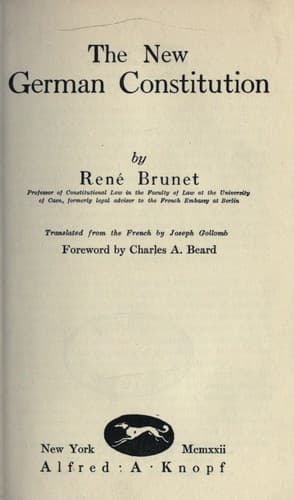
Germany -- Politics and government -- 1918-1933; Germany. Verfassung (1919)
REICHSVERWALTUNGSGERICHT National Administrative Court
REICHSWIRTSCHAFTSRAT National Economic Council
LAND State (an integral part of the
Commonwealth)
LANDES- of the State, State
LANDESREGIERUNG State Cabinet
LANDTAG State Assembly
WAHLPRÜFUNGSGERICHT Electoral Commission
STAAT country, state (one of the family
of nations); referring to Germany,
it designates the Commonwealth and
separate States as a single
political entity.
STAATSGERICHTSHOF Supreme Judicial Court
STAATLICH political
FREISTAATLICH republican
APPENDIX
THE CONSTITUTION OF THE GERMAN COMMONWEALTH
_PREAMBLE_
The German People, united in all their branches, and inspired by the
determination to renew and strengthen their Commonwealth in liberty and
justice, to preserve peace both at home and abroad, and to foster social
progress, have adopted the following Constitution.
PART ONE
Structure and Functions of the Commonwealth
_SECTION I_
COMMONWEALTH AND STATES
ARTICLE 1
The German Commonwealth is a republic.
Political authority is derived from the People.
ARTICLE 2
The territory of the Commonwealth consists of the territories of
the German States. Other territories may be incorporated into the
Commonwealth by national law, if their inhabitants, exercising the right
of self-determination, so desire.
ARTICLE 3
The national colours are black, red and gold. The merchant flag is black,
white and red, with the national colours in the upper inside corner.
ARTICLE 4
The generally recognized principles of the law of nations are accepted as
an integral part of the law of the German Commonwealth.
ARTICLE 5
Political authority is exercised in national affairs by the National
Government in accordance with the Constitution of the Commonwealth, and
in State affairs by the State Governments in accordance with the State
constitutions.
ARTICLE 6
The Commonwealth has exclusive jurisdiction over:
1. Foreign relations;
2. Colonial affairs;
3. Citizenship, freedom of travel and residence, immigration and
emigration, and extradition;
4. Organization for national defence;
5. Coinage;
6. Customs, including the consolidation of customs and trade districts
and the free interchange of goods;
7. Posts and telegraphs, including telephones.
ARTICLE 7
The Commonwealth has jurisdiction over:
1. Civil law;
2. Criminal law;
3. Judicial procedure, including penal administration, and official
co-operation between the administrative authorities;
4. Passports and the supervision of aliens;
Public-domain text, read in full here on John Shaqi.
Reviews
Reviews
No reviews yet
Be the first to share your thoughts on this work.
Elsewhere in the archive
Join the Discussion
Join the discussion
Sign in to leave a comment or review.
Sign InorCreate an account