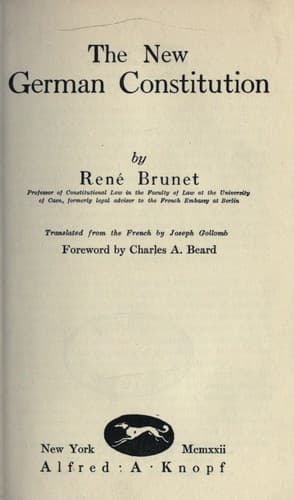
Germany -- Politics and government -- 1918-1933; Germany. Verfassung (1919)
The quorum to do business will be regulated by the rules of procedure.
ARTICLE 33
The National Assembly and its committees may require the presence of the
National Chancellor and of any National Minister.
The National Chancellor, the National Ministers, and Commissioners
designated by them, have the right to be present at the sittings of the
National Assembly and of its committees. The States are entitled to send
their plenipotentiaries to these sittings to submit the views of their
Cabinets on matters under consideration.
At their request the representatives of the Cabinets shall be heard
during the deliberations, and the representatives of the National Cabinet
shall be heard even outside the regular order of business.
They are subject to the authority of the presiding officer in matters of
order.
ARTICLE 34
The National Assembly has the right, and, on proposal of one-fifth of
its members, the duty to appoint committees of investigation. These
committees, in public sittings, inquire into the evidence which they,
or the proponents, consider necessary. The public may be excluded by a
two-thirds vote of the committee of investigation. The rules of procedure
regulate the proceedings of the committee and determine the number of its
members.
The judicial and administrative authorities are required to comply with
requests by these committees for information, and the record of the
authorities shall on request be submitted to them.
The provisions of the code of criminal procedure apply as far as is
suitable to the inquiries of these committees and of the authorities
assisting them, but the secrecy of letter and other post, telegraph, and
telephone services will remain inviolate.
ARTICLE 35
The National Assembly appoints a Standing Committee on foreign affairs
which may also act outside of the sittings of the National Assembly
and after its expiration or dissolution until a new National Assembly
convenes. Its sittings are not public, unless the committee by a
two-thirds vote otherwise provides.
The National Assembly also appoints a Standing Committee for the
protection of the rights of the representatives of the People against the
National Cabinet during a recess and after the expiration of the term for
which it was elected.
These committees have the rights of committees of investigation.
ARTICLE 36
No member of the National Assembly or of a State Assembly shall at any
time whatsoever be subject to any judicial or disciplinary prosecution
or be held responsible outside of the House to which he belongs on
account of his vote or his opinions uttered in the performance of his
duty.
ARTICLE 37
No member of the National Assembly or of a State Assembly shall during
the session, without the consent of the House to which he belongs, be
subject to investigation or arrest on account of any punishable offence,
unless he is caught in the act, or apprehended not later than the
following day.
Public-domain text, read in full here on John Shaqi.
Reviews
Reviews
No reviews yet
Be the first to share your thoughts on this work.
Elsewhere in the archive
Join the Discussion
Join the discussion
Sign in to leave a comment or review.
Sign InorCreate an account