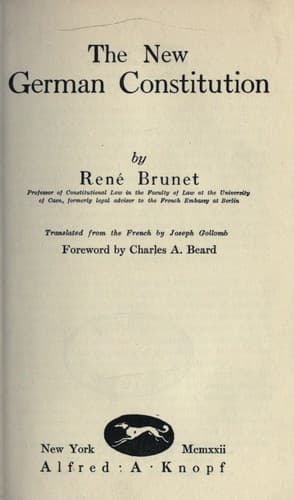
Germany -- Politics and government -- 1918-1933; Germany. Verfassung (1919)
The details will be regulated by the national election law.
ARTICLE 23
The National Assembly is elected for four years. New elections must take
place at the latest on the sixtieth day after its term comes to an end.
The National Assembly convenes at the latest on the thirtieth day after
the election.
ARTICLE 24
The National Assembly meets each year on the first Wednesday in November
at the seat of the National Government. The President of the National
Assembly must call it earlier if the President of the Commonwealth, or at
least one-third of the members of the National Assembly, demand it.
The National Assembly determines the close of its session and the day of
re-assembling.
ARTICLE 25
The President of the Commonwealth may dissolve the National Assembly, but
only once for the same cause.
The new election occurs at the latest on the sixtieth day after such
dissolution.
ARTICLE 26
The National Assembly chooses its President, Vice-President and its
Secretaries. It regulates its own procedure.
ARTICLE 27
During the interval between sessions, or while elections are taking
place, the President and Vice-President of the preceding session conduct
its affairs.
ARTICLE 28
The President administers the regulations and policing of the National
Assembly building. The management of the building is subject to his
direction; he controls its receipts and expenses in accordance with the
provisions of the budget, and represents the Commonwealth in all legal
affairs and in litigation arising during his administration.
ARTICLE 29
The proceedings of the National Assembly are public. At the request of
fifty members the public may be excluded by a two-thirds vote.
ARTICLE 30
True and accurate reports of the proceedings in public sittings of the
National Assembly, of a State Assembly, or of their committees, are
absolutely privileged.
ARTICLE 31
An Electoral Commission to decide disputed elections will be organized
in connection with the National Assembly. It will also decide whether a
delegate has forfeited his seat.
The Electoral Commission consists of members of the National Assembly,
chosen by the latter for the life of the Assembly, and of members of the
National Administrative Court, to be appointed by the President of the
Commonwealth on the nomination of the presidency of this court.
This Electoral Commission pronounces judgment after public hearings
through a quorum of three members of the National Assembly and two
judicial members.
Proceedings apart from the hearings before the Electoral Commission will
be conducted by a National Commissioner appointed by the President of the
Commonwealth. In other respects the procedure will be regulated by the
Electoral Commission.
ARTICLE 32
The National Assembly acts by majority vote unless otherwise provided in
the Constitution. For the conduct of elections by the National Assembly
it may, in its rules of procedure, make exceptions.
Public-domain text, read in full here on John Shaqi.
Reviews
Reviews
No reviews yet
Be the first to share your thoughts on this work.
Elsewhere in the archive
Join the Discussion
Join the discussion
Sign in to leave a comment or review.
Sign InorCreate an account