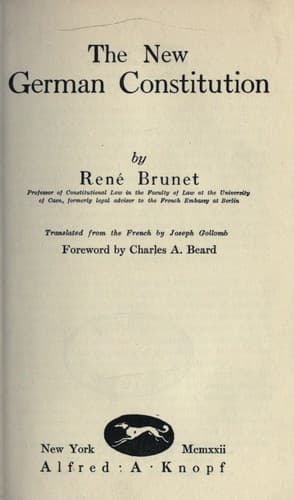
Germany -- Politics and government -- 1918-1933; Germany. Verfassung (1919)
b. _The Council of the Commissars of the People is strengthened._--The
congress, which declared itself invested with complete political power,
delegated legislative and executive power to the Council of Commissars
of the People up to the time the National Assembly convened. Further, it
nominated a central committee (Zentralrat) of the Workers and Soldiers
Councils of Germany, consisting of twenty-seven members which was to
exercise parliamentary control over the German and Prussian cabinets;
that is to say, according to the official explanation of Commissar of the
People Haase, all projects of law must be submitted by the Council of the
Commissars of the People to the Central Committee and discussed by them.
The Central Committee had the right to appoint and recall Commissars of
the People for Prussia and for the Reich. Finally the Council of the
Commissars of the People was to appoint to each Secretary of State two
delegates, a Social Democrat and an Independent, who would be charged
with the conduct of affairs within the ministries. As for the Executive
Committee of the Workers and Soldiers Councils of Berlin it was limited
by the congress to authority only in matters pertaining to the Berlin
group.
c. _Elections for the National Assembly are held January 19, 1919._--The
victory of the Social Democrats was complete. The Independents, because
of the small number of representatives they had elected, refused to form
a part of the Central Committee, which thereupon consisted only of Social
Democrats and was presided over by Leinert, then by Max Cohen, both very
moderate in their opinions. The conflict between the Executive Committee
of Workers and Soldiers Councils of Berlin and the Central Committee
never gave the government any trouble.
But the Independents and the Spartacists had not at all decided to give
up the game, for they believed themselves to be at least “masters of
the street.” And Christmas week of 1918 in Berlin was a bloody one. A
detachment of marines which had installed itself in the royal castle
and had refused to leave it in spite of the orders of the government
of Prussia had tried to capture Commissars of the People, Ebert and
Landsberg, to keep them as hostages against the non-payment of wages due
them. Their attempt failed and troops were summoned by the government to
force the sailors to leave the castle. Bloody fights ensued in Berlin
which lasted till Christmas.
Public-domain text, read in full here on John Shaqi.
Reviews
Reviews
No reviews yet
Be the first to share your thoughts on this work.
Join the Discussion
Join the discussion
Sign in to leave a comment or review.
Sign InorCreate an account