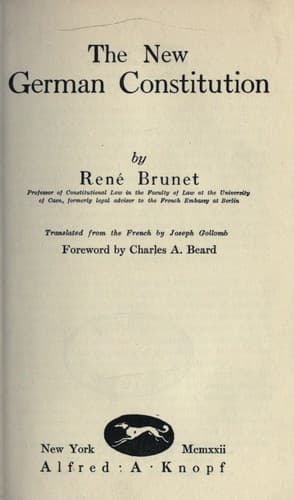
Germany -- Politics and government -- 1918-1933; Germany. Verfassung (1919)
The National Cabinet issues the general administrative regulations
necessary for the execution of the national laws so far as the laws
do not otherwise provide. It must secure the assent of the National
Council if the execution of the national laws is assigned to the State
authorities.
_SECTION VI_
THE NATIONAL ADMINISTRATION
ARTICLE 78
The conduct of relations with foreign countries is exclusively a function
of the Commonwealth.
The States, in matters subject to their jurisdiction, may conclude
treaties with foreign countries; such treaties require the assent of the
Commonwealth.
Agreements with foreign countries regarding changes of national
boundaries will be concluded by the Commonwealth with the consent of the
State concerned. Changes of boundaries may be made only by authority of a
national law, except in cases where a mere adjustment of the boundaries
of uninhabited districts is in question.
To assure the representation of interests arising from the special
economic relations of individual States to foreign countries or from
their proximity to foreign countries, the Commonwealth determines
the requisite arrangements and measures in agreement with the States
concerned.
ARTICLE 79
The national defence is a function of the Commonwealth. The organization
of the German People for defence will be uniformly regulated by a
national law with due consideration for the peculiarities of the people
of the separate States.
ARTICLE 80
Colonial policy is exclusively a function of the Commonwealth.
ARTICLE 81
All German merchant ships constitute a unified merchant marine.
ARTICLE 82
Germany forms a customs and trade area surrounded by a common customs
boundary.
The customs boundary is identical with the international boundary. At
the seacoast the shore of the mainland and of the islands belonging to
the national territory constitutes the customs boundary. Deviations may
be made for the course of the customs boundary at the ocean and at other
bodies of water.
Foreign territories or parts of territories may be incorporated in the
customs area by international treaties or agreements.
Portions of territory may be excluded from the customs area in accordance
with special requirements. In the case of free ports this exclusion may
be discontinued only by an amendment to the Constitution.
Districts excluded from the customs area may be included within a foreign
customs area by international treaties or agreements.
All products of nature or industry, as well as works of art, which are
subjects of free commerce within the Commonwealth, may be transported
in any direction across State and municipal boundaries. Exceptions are
permissible by authority of national law.
ARTICLE 83
Customs duties and taxes on articles of consumption are administered by
the national authorities.
Public-domain text, read in full here on John Shaqi.
Reviews
Reviews
No reviews yet
Be the first to share your thoughts on this work.
Elsewhere in the archive
Join the Discussion
Join the discussion
Sign in to leave a comment or review.
Sign InorCreate an account