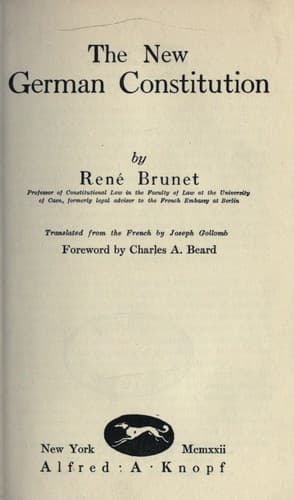
Germany -- Politics and government -- 1918-1933; Germany. Verfassung (1919)
A law enacted by the National Assembly shall be referred to the People
before its promulgation, if the National President so orders within a
month.
A law whose promulgation is deferred at the demand of at least
one-third of the National Assembly shall be submitted to the People, if
one-twentieth of the qualified voters so petition.
A popular vote shall further be resorted to on a measure initiated by
the People if one-tenth of the qualified voters so petition. A fully
elaborated bill must accompany such petition. The National Cabinet
shall lay the bill together with a statement of its attitude before the
National Assembly. The popular vote does not take place if the desired
bill is enacted without amendment by the National Assembly.
A popular vote may be taken on the budget, tax laws, and laws relating to
the classification and payment of public officers only by authority of
the National President.
The procedure in connection with the popular referendum and initiative
will be regulated by national law.
ARTICLE 74
The National Council has the right to object to laws passed by the
National Assembly.
The objection must be filed with the National Cabinet within two weeks
after the final vote in the National Assembly and must be supported by
reasons within two more weeks at the latest.
In case of objection, the law is returned to the National Assembly for
reconsideration. If an agreement between the National Assembly and the
National Council is not reached, the National President may within three
months refer the subject of the dispute to the People. If the President
makes no use of this right, the law does not go into effect. If the
National Assembly disapproves by a two-thirds majority the objection of
the National Council, the President shall promulgate the law in the form
enacted by the National Assembly within three months or refer it to the
People.
ARTICLE 75
An act of the National Assembly may be annulled by a popular vote, only
if a majority of those qualified take part in the vote.
ARTICLE 76
The Constitution may be amended by process of legislation. But acts of
the National Assembly relating to the amendment of the Constitution are
effective only if two-thirds of the legal membership are present, and at
least two-thirds of those present give their assent. Acts of the National
Council relating to the amendment of the Constitution also require
a two-thirds majority of all the votes cast. If an amendment to the
Constitution is to be adopted by the People by popular initiative, the
assent of a majority of the qualified voters is required.
If the National Assembly adopts an amendment to the Constitution against
the objection of the National Council, the President may not promulgate
this law, if the National Council within two weeks demands a popular vote.
ARTICLE 77
Public-domain text, read in full here on John Shaqi.
Reviews
Reviews
No reviews yet
Be the first to share your thoughts on this work.
Elsewhere in the archive
Join the Discussion
Join the discussion
Sign in to leave a comment or review.
Sign InorCreate an account